Sports & Super
Pegassi Torero
Pegassi · Sports Classic
- Seats
- 2
- Drivetrain
- RWD
- Top speed
- ~118 mph / 190 km/h
- Price
- ~$498,000
- Mass
- 1,200 kg
- Real-world inspiration
- Lamborghini Countach
- Availability
- Acquired through the classic dealer at the north end of the Vice City marina, private collector sale, or coastal auction weekends; not available new.
- Overview
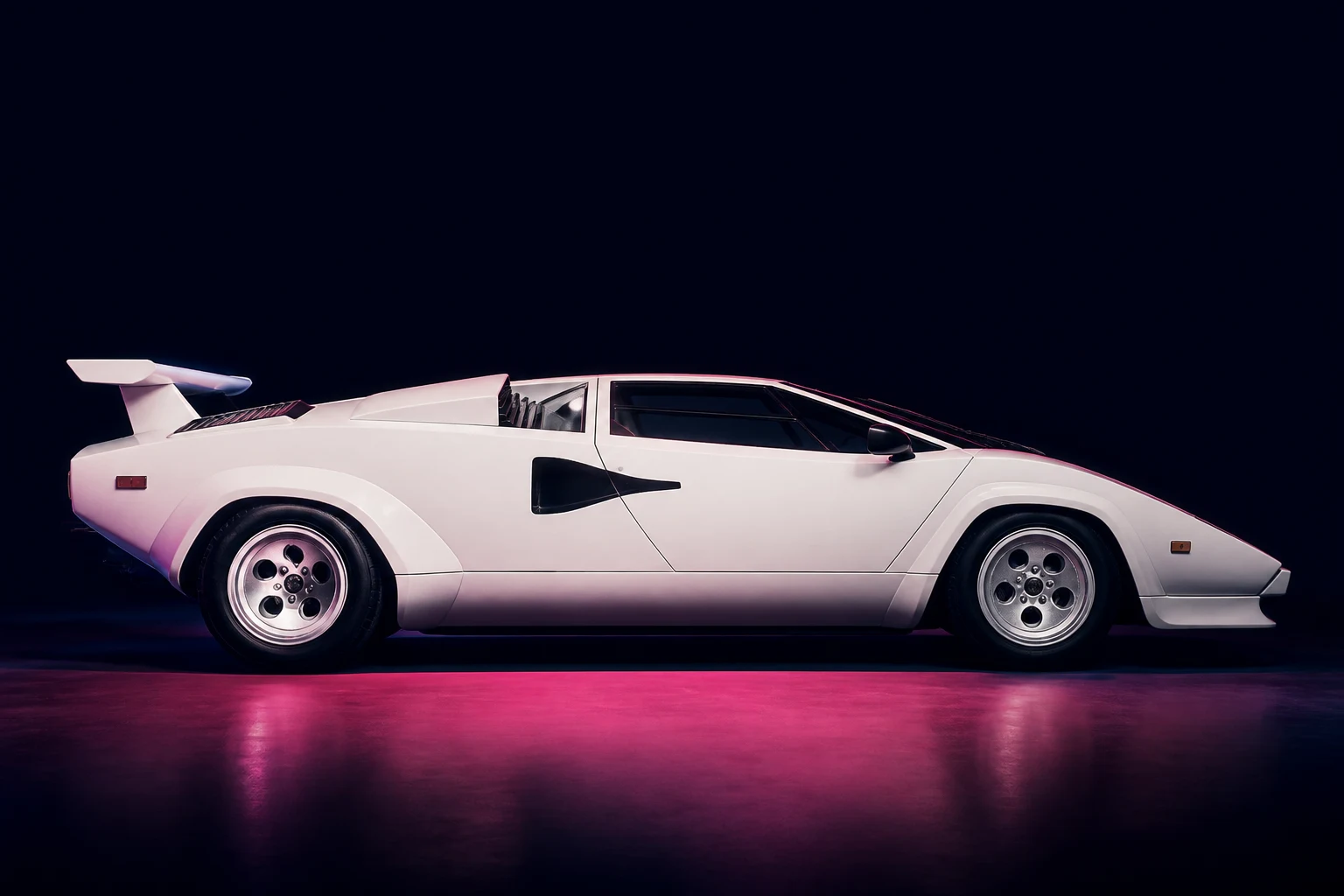
- The wedge that invented the poster car - a period Pegassi with scissor doors, a bolt-on wing and absolutely no interest in your comfort, and still the most charismatic thing on Ocean Drive.
Description
There is a very short list of cars that changed what a fast car was supposed to look like, and the Pegassi Torero is at the top of it. Before the Torero, exotic cars were curved. After it, for two decades, they were wedges - flat planes, chopped tails, doors that opened upward, and a nose so low you could not see the end of it from the driver's seat. Every angular supercar that followed is arguing with a shape that Pegassi drew first.
In Leonida the Torero is not really a car in the practical sense. It is a cultural object. It sits in the collection of a Vice City hotel owner, or in the back of a Rideout Customs bay under a cover, or occasionally rolling slowly down Ocean Drive at dusk in that specific shade of period white while every phone on the sidewalk comes up. The state has a genuine affection for it that it does not extend to the newer, faster, more competent machinery.
Driving one is an education in how much modern cars do for you. The steering is enormously heavy at low speed. The clutch requires a deliberate effort. Rearward visibility is functionally zero, to the extent that the accepted method for reversing a Torero is to open the door, sit up on the sill and steer with one hand while looking backward over the roof. There are no driver aids of any kind. The pedals are offset. It is hot inside, always.
And none of that matters, because when the road opens up and the engine comes onto the cam behind your head, the Torero delivers an experience that none of the newer cars can. It is loud, mechanical, slightly frightening and completely analogue. In a state full of hypercars that flatter their drivers, the Torero is the one that makes you earn it, and the people in Leonida who own them would not trade for anything.
Design
The Torero is a folded sheet of a car. The nose is a shallow wedge barely a metre off the ground, the windscreen rakes back at an extreme angle into a low flat roof, and the tail is cut off vertically behind the engine bay. The famous NACA ducts are scooped into the flanks ahead of the rear wheels, feeding air to the radiators, and the rear haunches flare out over enormous period-width tires.
The scissor doors were a packaging solution before they were a statement - the sills are so wide that a conventional door would have been unusable - and they remain the car's defining gesture. The optional rear wing, bolted high across the tail, adds nothing aerodynamically and everything visually, and virtually every Torero in Leonida has one.
Inside it is period-correct in every uncomfortable way. Deep bucket seats, a small deeply dished wheel, an open-gate metal shifter, and a dashboard of individual round dials in a leather binnacle. The rear window is a series of horizontal louvres. The air conditioning is best described as optimistic.
Performance
By the standards of modern Leonida exotics the Torero is not fast, but it is fast in a way that feels considerably more dramatic than the numbers. The naturally aspirated engine builds power high in the range, so the car requires revs and rewards commitment, and the whole experience arrives with a mechanical intensity - induction noise, vibration through the shifter, heat coming through the bulkhead - that the newer cars have engineered away.
Handling is pure period rear-drive. There is enormous grip at the rear from those wide tires and comparatively little at the front, which means the Torero understeers gently at moderate pace and then, if you provoke it, snaps into oversteer with very little transition. It is entirely manageable if you are paying attention and entirely unforgiving if you are not.
Braking is the weakest part of the package and the one most likely to catch out a driver coming from something modern. The discs are period items with no electronic assistance, they fade after repeated hard use, and the pedal requires a genuinely heavy push. Leave twice the braking distance you think you need, especially into the Keys bridge junctions.
Driving & Gameplay
Drive the Torero with the brakes in mind at all times. Everything else about the car can be managed with commitment, but the stopping distances are genuinely long by modern standards and they get longer as the discs heat up. Plan your entry to every junction one beat earlier than instinct suggests and the car becomes far less intimidating.
Use the mid-range and short-shift out of tight corners. The rear-drive layout, period tires and short wheelbase make it easy to break traction on corner exit, and a Torero that steps out at low speed in a Little Cuba side street will be into a parked car before you finish correcting. Get the wheel straight, then feed the power in.
Where it genuinely shines is the open coastal road. Long sweeping bends, good sightlines, and a surface that does not change - the Torero is glorious there, holding a fast line with the engine screaming behind you and the whole car communicating through the wheel. Take it out to the Keys at sunrise and you will understand why people in Leonida keep paying half a million for a car with no air conditioning.
Customization
Rideout Customs runs a small specialist bench for period Pegassi work, and the Torero menu reflects the car's status - this is restoration and period-correct modification rather than a modern tuning catalog. Options include the factory wing, period wheel designs in several widths, a selection of era-authentic paint colors including the definitive whites, reds and light metallics, and interior retrims in the original leather patterns.
Mechanical work is available but the shop steers customers toward reliability rather than power: uprated cooling, a rebuilt braking system with modern friction material, and a careful engine refresh rather than forced induction. A handful of Leonida owners have gone the other way and built genuinely violent modified Toreros with turbo conversions and modern rubber, and the results are as terrifying as they sound.
Locations
The Torero is not sold new anywhere in Leonida. Examples change hands through the classic dealer on the north side of the Vice City marina, through private sale between collectors, and occasionally at the coastal auction events that draw money in from out of state for a weekend.
In the world it turns up where old money and nostalgia intersect. The forecourts of the older Ocean Drive hotels, the collector garages on the mainland side, the show-and-shine gatherings that fill a Vice Beach parking lot on Sunday mornings, and the Rideout Customs restoration bay where there is very often one up on a lift with its engine cover off.
In Leonida
Toreros arrived in Vice City new, in the era when the state's coastal money was at its most extravagant and least examined. They were the definitive car of that period - parked outside the clubs, driven badly along the beachfront, occasionally abandoned in a canal - and a surprising number survived precisely because they were too impractical to use as daily transport and ended up preserved in garages.
That survival gave the state one of the densest concentrations of the model anywhere, and it made the Torero permanently synonymous with Vice City itself. The shape is on postcards. It is painted on the side of at least three buildings in the beach district. When Leonida wants to depict its own history, it draws a low white wedge with the doors up, and everyone immediately knows exactly what era is being invoked.
Trivia
- The accepted way to reverse a Torero is to open the door and sit on the sill, because rearward visibility is effectively zero.
- The rear wing produces no meaningful downforce and slightly reduces top speed, and nearly every owner fits one anyway.
- The NACA ducts in the flanks are functional radiator feeds, not styling elements.
- Vice City has one of the highest surviving concentrations of the model anywhere, largely because owners drove them so rarely.
- The car's silhouette appears on murals in at least three separate buildings around the Vice Beach district.