Boats & Seaplanes
Nagasaki Dinghy
Nagasaki · Rigid-hulled inflatable
- Seats
- 4
- Top speed
- ~38 knots / 44 mph
- Price
- ~$26,000
- Mass
- 1,100 kg
- Real-world inspiration
- Zodiac Hurricane / military rigid-hulled inflatable boats
- Availability
- Available cheaply from any utility marina from the earliest coastal missions, and freely available to steal from ranger docks and Keys boat ramps.
- Overview
- The unglamorous rigid-hulled inflatable that quietly carries four people, one crate, and zero questions onto any beach in Leonida.
Description
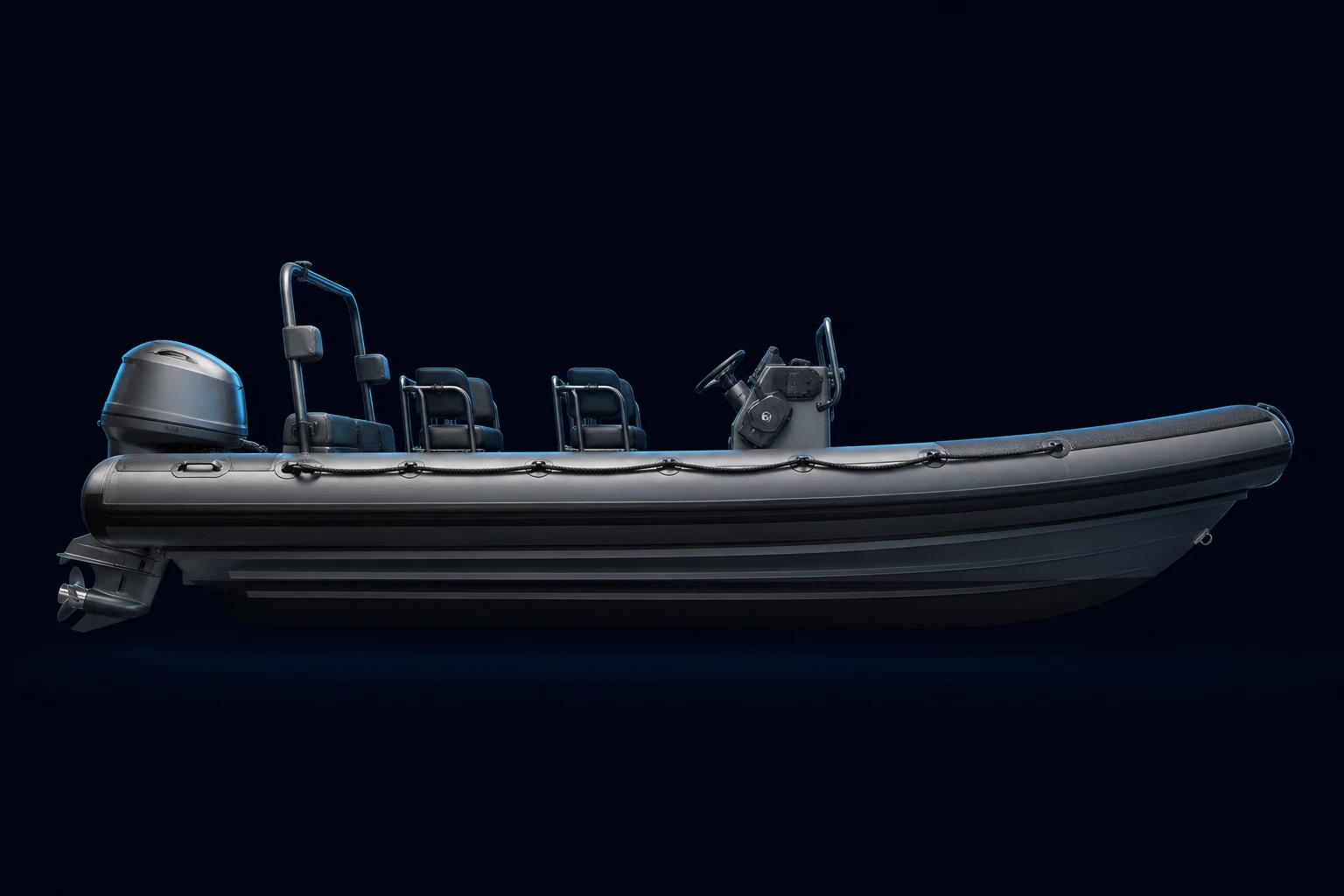
The Nagasaki Dinghy is the least exciting boat in Leonida and probably the most useful. It is a rigid-hulled inflatable - a fiberglass vee hull ringed by a heavy inflatable collar, driven by outboards, with an open deck and absolutely no pretensions. Nobody buys one to impress anybody. People buy them because when the plan calls for four crew, a case of hardware, and a landing on a beach with no dock, nothing else does the job.
What the inflatable collar buys you is forgiveness. You can bounce a Dinghy off a piling, drag it up a shell beach, wedge it into a mangrove root ball, and load it beyond any reasonable interpretation of its rating, and it just keeps floating. The collar makes it nearly impossible to capsize, absorbs impacts that would hole a conventional hull, and doubles as seating when the four proper positions are full. It is the boat equivalent of a beat-up pickup truck, and it is treated with exactly the same affection.
In Leonida the Dinghy has three lives running in parallel. It is genuine working equipment for park rangers, marine researchers, and dive operators in the Keys. It is standard-issue support gear for every agency that patrols the Grassrivers. And it is the single most common vehicle used to put people ashore somewhere they aren't supposed to be, which is why finding one drifting empty in a backwater channel raises no eyebrows and answers no questions.
For players, it's the cheap boat you buy early, use constantly, and never quite retire. Long after you own something faster and prettier, the Dinghy is still the one you take when the job involves shallow water, a full crew, and the need to leave no trace.
Design
The layout is pure function. A moulded fiberglass vee hull provides the running surface and the structure; a segmented inflatable collar wraps the sheer from bow to transom, tapering into two pointed cones at the stern that keep the back end buoyant when the outboards drag it down. Rope grab lines run the full perimeter, which is how boarding actually works in practice.
The deck is open and self-draining, floored with textured nonskid and interrupted only by a small center console, four jockey-style seats, and a pair of stowage lockers set into the sole. The console carries a wheel, a throttle, a compass, and a depth sounder - the complete inventory of instrumentation. Everything is bolted down, because the deck routinely takes green water over the bow.
Nagasaki finishes them in flat grey, olive, or a faded white that turns the color of old chalk after a season in the Leonida sun. Working boats wear stenciled hull numbers and agency markings; private ones tend to wear nothing at all, which is very much the point. The whole thing folds into a package light enough to be trailered behind a pickup or slung under a helicopter, and Leonida crews exploit both options constantly.
Performance
Speed is modest and completely adequate. The outboards push the Dinghy to a genuine planing speed that will outrun anything under oars and keep pace with most working craft, and because the boat weighs so little it gets there almost immediately. Loaded with four people and gear, it slows noticeably, which is worth planning around when the beach you're leaving is contested.
Where it excels is water nobody else can use. Draft is measured in inches, so the Dinghy runs over sandbars, oyster bars, and flooded grass that would stop a conventional hull cold. The inflatable collar means glancing contact with obstacles is a bump rather than a catastrophe, and the flat, stable platform lets passengers shoot, spot, or work from the deck without the boat rolling out from under them.
In rough water it is a punishing but safe ride. The light hull slams hard in chop and everyone gets soaked, but the collar keeps it upright through conditions that would swamp an open runabout. Its real limitation is exposure: nothing on the boat protects the crew, and a Dinghy that gets caught in open water by something faster has no answer at all.
Driving & Gameplay
The Dinghy is the crew-transport answer for anything that starts on water. Four seats means a full team arrives together instead of trickling in, and the shallow draft means the approach can be from a direction nobody is watching. Missions that hinge on reaching a stilt house, a sandbar, or an unguarded stretch of beach are designed around exactly this capability.
It is also the best stealth boat in the game, in the practical sense that nobody reacts to it. Patrols, dock workers, and residents ignore a Dinghy the way they ignore a delivery van, which lets you idle into places a Speeder would get flagged instantly. Cut the outboards and paddle the last hundred yards and you can put a crew ashore without triggering anything.
The tradeoff is that it cannot win a fight or a chase. Once you're spotted and pursued in open water, the Dinghy's options are the shallows or surrender. Good play with one is entirely about the route: pick a landing with a channel escape behind it, keep the mangroves within reach, and never let yourself be pushed out into deep water.
Customization
Utility outfitters treat the Dinghy as a platform rather than a product. You can specify collar and hull color in flat grey, olive drab, sand, or a dull matte black for night work, add stenciled hull numbers or fake agency markings, and fit a low-profile canvas cover that makes the boat read as abandoned when it's beached.
The functional options are the reason people build them out. Outboard upgrades trade fuel range for speed, a bow-mounted spotlight and a red-filtered chart light handle night navigation, extra fuel cans and a deck rack expand the operating radius into serious Grassrivers territory, and a reinforced transom plate supports heavier motors. A soft-mount weapon post can be fitted to the console rail, though nothing about the boat will protect the person using it.
Locations
Dinghies are everywhere along the water and nowhere in particular. Ranger stations throughout the Grassrivers keep them on trailers and davits, dive shops in the Keys rent them by the day, and marine research docks always have a few tied up with equipment still aboard.
The informal supply is even larger. Look behind fish houses, under stilt homes, and along the mangrove edges of the Keys, where they sit half-pulled onto the mud waiting for owners who may or may not return. Port Gellhorn's commercial harbor keeps them as tenders alongside larger vessels, and any beach in Leonida with a road within walking distance will eventually produce one.
In Leonida
Nagasaki's inflatable line began as a contract build for coastal rescue services, which is why the collar geometry and self-draining deck are so much better resolved than the boat's price implies. The design barely changed over its production life because there was nothing to fix - agencies kept reordering the same hull, and Nagasaki kept building it.
Its spread through Leonida's informal economy was inevitable. Surplus boats came off agency inventories by the hundreds, sold cheaply and untraceably, and within a few years the Dinghy had become the default tool for anyone moving people or product through the Grassrivers. Enforcement agencies now find themselves chasing the same boats they retired, in the same waters they bought them for, which is a joke told frequently and enjoyed by nobody in uniform.
Trivia
- The pointed collar cones at the stern are officially buoyancy chambers and unofficially the most comfortable seats on the boat.
- Leonida ranger crews stencil their hull numbers on the collar rather than the fiberglass, because the collar is the part that gets replaced least often.
- A Dinghy can be slung under a utility helicopter and dropped directly into the Grassrivers, a technique used by both rescue services and people avoiding them.
- Because the collar is segmented, puncturing one chamber barely affects the boat - a design detail that has ended more than one interception badly.
- Keys locals call an abandoned Dinghy found in the mangroves a 'ghost skiff,' and the unwritten rule is that you leave it exactly where you found it.