Aircraft
Nagasaki Buzzard Attack Chopper
Nagasaki · Light attack helicopter
- Seats
- 2
- Top speed
- ~150 knots / 173 mph
- Price
- Restricted - no civil sale
- Mass
- 1,700 kg
- Real-world inspiration
- MH-6 / AH-6 Little Bird
- Availability
- No legitimate purchase exists. Acquisition means taking one from a contractor compound, an offshore deck, or a mainland reserve field - all of which are defended, and all of which will notice.
- Overview
- A compact, agile light attack helicopter that fits where nothing armed should - rockets and miniguns on an airframe the size of a delivery van.
Description
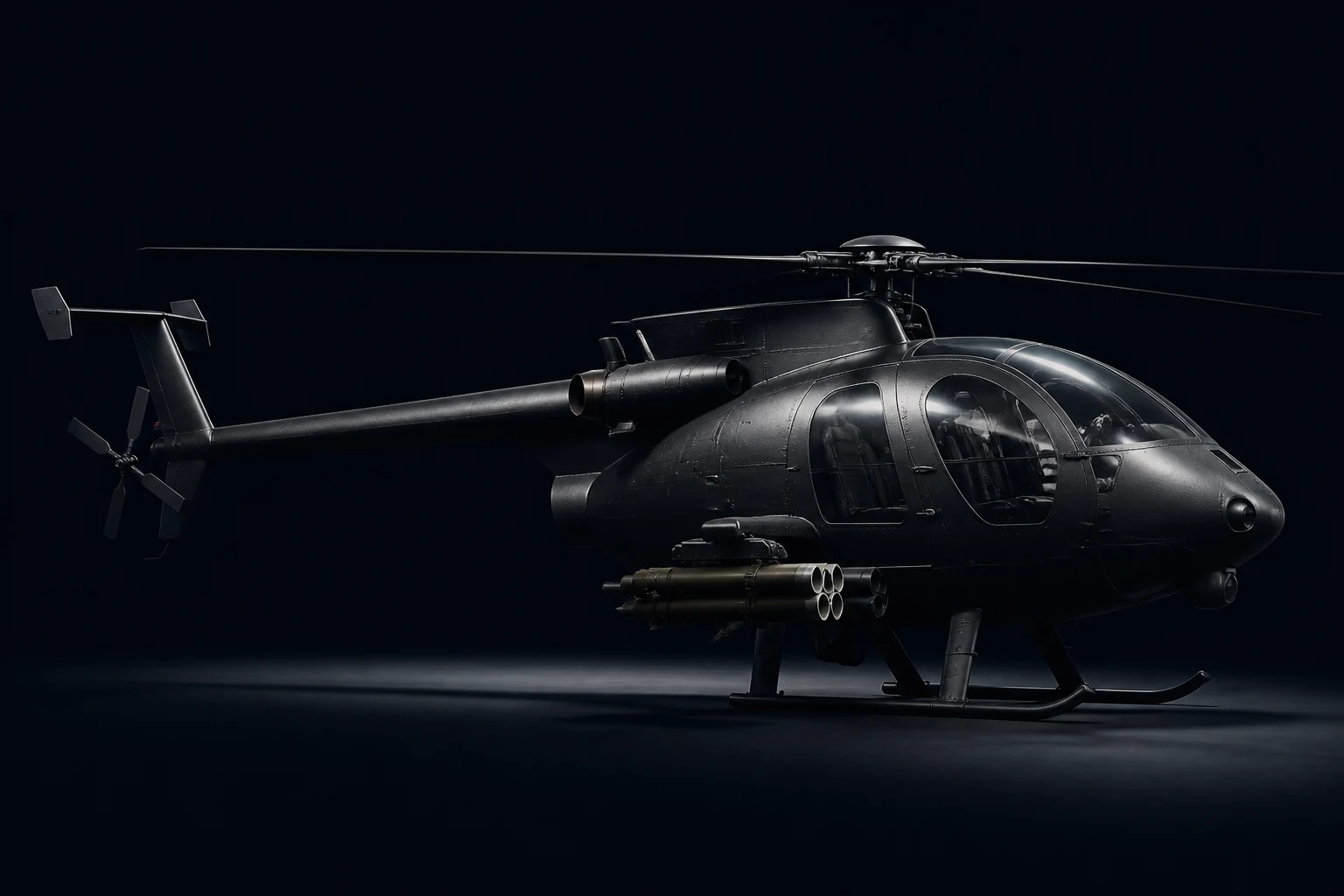
The Nagasaki Buzzard Attack Chopper is a small helicopter with a serious weapons fit, and the disparity between those two facts is the entire point. It's built on a light utility airframe barely larger than a civilian trainer, and onto that Nagasaki has bolted stub pylons carrying rocket pods and forward-firing miniguns. The result is an aircraft that can operate from spaces no attack helicopter should be able to use and still deliver ordnance like one that can't.
What makes it effective in a place like Leonida is size. A conventional gunship needs room - approach lanes, clear landing zones, somewhere to hide. The Buzzard fits between buildings. It can come up a Vice City canal at rooftop height, cross a Keys island below the treeline, or sit down in a Grassrivers clearing that a Maverick would think twice about. In an environment defined by dense urban geometry and awkward terrain, that agility is worth more than armor or payload.
The tradeoff is that it's fragile. There's no meaningful protection on the airframe, the crew sit behind glass, and a light helicopter loaded with rockets is not a forgiving thing to be in when someone shoots back effectively. The Buzzard is a scalpel: it works brilliantly when it arrives first, from an unexpected direction, and leaves before the response organizes. It works very badly in a stand-up fight.
Officially the type is restricted to the mainland installations and to certain contractor operators with the appropriate paperwork. In practice, Leonida's private security industry is large, well-funded, and creatively regulated, and Buzzards turn up in places that suggest the paperwork is more flexible than advertised.
Design
The Buzzard is built around an egg - a compact, almost spherical cockpit module with wraparound glazing that gives the two-person crew close to unobstructed visibility in every direction including down. Behind it, the airframe narrows immediately into a slim tail boom, and the whole thing sits on lightweight skid gear with external bench platforms where the utility variant carries passengers.
The rotor system is a multi-blade fully articulated head, noticeably smoother and quieter than the two-blade arrangement on civilian light helicopters, and small enough in diameter to let the aircraft operate in confined spaces. The tail rotor is proportionally large for the airframe, giving it aggressive yaw authority.
The weapons fit is what changes the aircraft's character. Stub pylons project from the fuselage sides at cabin level, carrying seven-tube rocket pods outboard and rotary cannon inboard, with a simple reflector sight in the cockpit and ammunition boxes occupying the space the utility variant uses for cargo. Standard finish is matte black or dark grey with no markings whatsoever - Nagasaki delivers them that way, and no operator in Leonida has ever asked for anything else.
Performance
The Buzzard is fast for a light helicopter and extraordinarily agile for anything armed. It accelerates hard, holds a cruise well above what the civilian light types manage, and changes direction with a snap that comes from having a very small rotor disc and very little mass to move around. Pilots who know the type fly it aggressively, using terrain and buildings in a way heavier gunships simply cannot.
In the hover it's precise and stable, which matters because the weapons are fixed forward - aiming means pointing the entire aircraft, and that requires fine control at low speed. The reflector sight is crude and effective at short range; anything beyond a few hundred meters is guesswork and volume of fire. Rockets are unguided, so accuracy is entirely a function of how well the pilot has set up the run.
The weaknesses are structural. There's no armor, no redundancy, and no margin: the airframe is a light helicopter carrying a load it was never designed around, and it handles noticeably differently with full pylons than with empty ones. Endurance is short, particularly with weapons weight aboard, and sustained ground fire will bring it down quickly. It wins by not being where the response is looking.
Driving & Gameplay
The Buzzard is the answer to fortified objectives. Its combination of speed, agility, and firepower means it can suppress a compound, clear a deck, or break up a convoy faster than any ground approach, and its small size lets it use approach routes - canals, streets, treelines - that keep it out of sight until it's already in range.
It's also the best fast-insertion aircraft in the game when the pylons come off. Six people on external benches, a top speed well above the civilian helicopters, and the ability to land in a space barely wider than the rotor disc make it the ideal way to put a crew directly onto a roof, a deck, or a clearing. A lot of the best play with a Buzzard involves never firing a shot.
What it can't do is absorb punishment or loiter. Endurance is short, the airframe is fragile, and once ground defenses are alert and oriented the aircraft's survival window closes fast. The correct pattern is a single decisive pass or a single fast insertion, then out - treating the Buzzard as an attack helicopter that can stay and fight is how players lose them.
Customization
Options are operational rather than decorative. The pylons accept different loads - rocket pods, rotary cannon, or a mixed fit, with a heavier long-range configuration available at a significant cost in agility and endurance. Removing the weapons entirely and refitting the external bench platforms converts the aircraft into a fast six-person insertion machine, which is how a surprising proportion of Buzzards in Leonida actually operate.
Avionics and signature options matter more than most operators expect. A night-vision-compatible cockpit fit, an infrared sensor turret under the nose, and an exhaust suppressor that cuts both the acoustic and thermal signature are all available. Paint runs to matte black, dark grey, and a low-contrast overwater scheme; markings are available and essentially never requested. Auxiliary fuel on the inboard stations addresses the type's short legs at the cost of a weapons station.
Locations
Officially the Buzzard operates from the restricted mainland installations - the Gellhorn Reserve field maintains a small rotary detachment, and Cape Verano Naval Air Station keeps several for coastal work. Both are fenced, patrolled, and take unauthorized approaches extremely seriously.
The unofficial distribution is broader and more interesting. Private security contractors operating out of secured compounds in the Vice City industrial belt keep unmarked examples on pads behind razor wire. Offshore platforms and certain very private Keys estates have helidecks with aircraft that nobody discusses. And every so often one appears sitting in a Grassrivers clearing or on a container stack at Port Gellhorn, engines running, waiting for something that is definitely not a scheduled transfer.
In Leonida
Nagasaki developed the type from its light utility line at the request of operators who wanted something small enough to move discreetly and armed enough to matter on arrival. The company kept the airframe changes minimal - the weapons fit is essentially a kit bolted to an existing helicopter - which is why the aircraft costs a fraction of a purpose-built gunship and why it handles like something that was never meant to carry rockets.
In Leonida the Buzzard's history is tangled up with the growth of the private security industry along the Gulf coast. Contractor operators bought them because they were cheap, capable, and easy to move between jobs, and the regulatory framework governing armed rotorcraft in the state has never quite caught up with the number of them now based here. The result is an aircraft with a genuine military pedigree that most Leonida residents will only ever see wearing no markings at all, flying low over an industrial compound at an hour when nothing legitimate is scheduled.
Trivia
- The weapons fit is a bolt-on kit, which means a Buzzard can be converted between attack and transport configuration by a competent crew in under an hour.
- Its multi-blade rotor is significantly quieter than the two-blade civilian light helicopters, and crews exploit the difference to arrive later in the noise budget than expected.
- The external bench platforms are rated for three people per side, a figure that Leonida contractor crews treat as advisory.
- Rockets are unguided, so accuracy depends entirely on the pilot's run-in - experienced Buzzard pilots practice approaches the way fixed-wing pilots practice landings.
- Nagasaki delivers the type unpainted and unmarked as standard, having concluded years ago that no customer was ever going to want anything else.