Aircraft
Mammoth Hydra
Mammoth · VTOL strike fighter
- Seats
- 1
- Top speed
- ~610 knots / 700 mph
- Price
- Restricted - no civil sale
- Mass
- 8,900 kg
- Real-world inspiration
- Hawker Siddeley Harrier / AV-8B jump jet
- Availability
- No legitimate acquisition path exists. Taking one from Cape Verano is a full operation in its own right - perimeter, patrols, and air defense - and keeping it flying afterward is a separate problem entirely.
- Overview
- A vectored-thrust jump jet that can hover over a Vice City rooftop and then be over the Keys before anyone finishes making the call.
Description
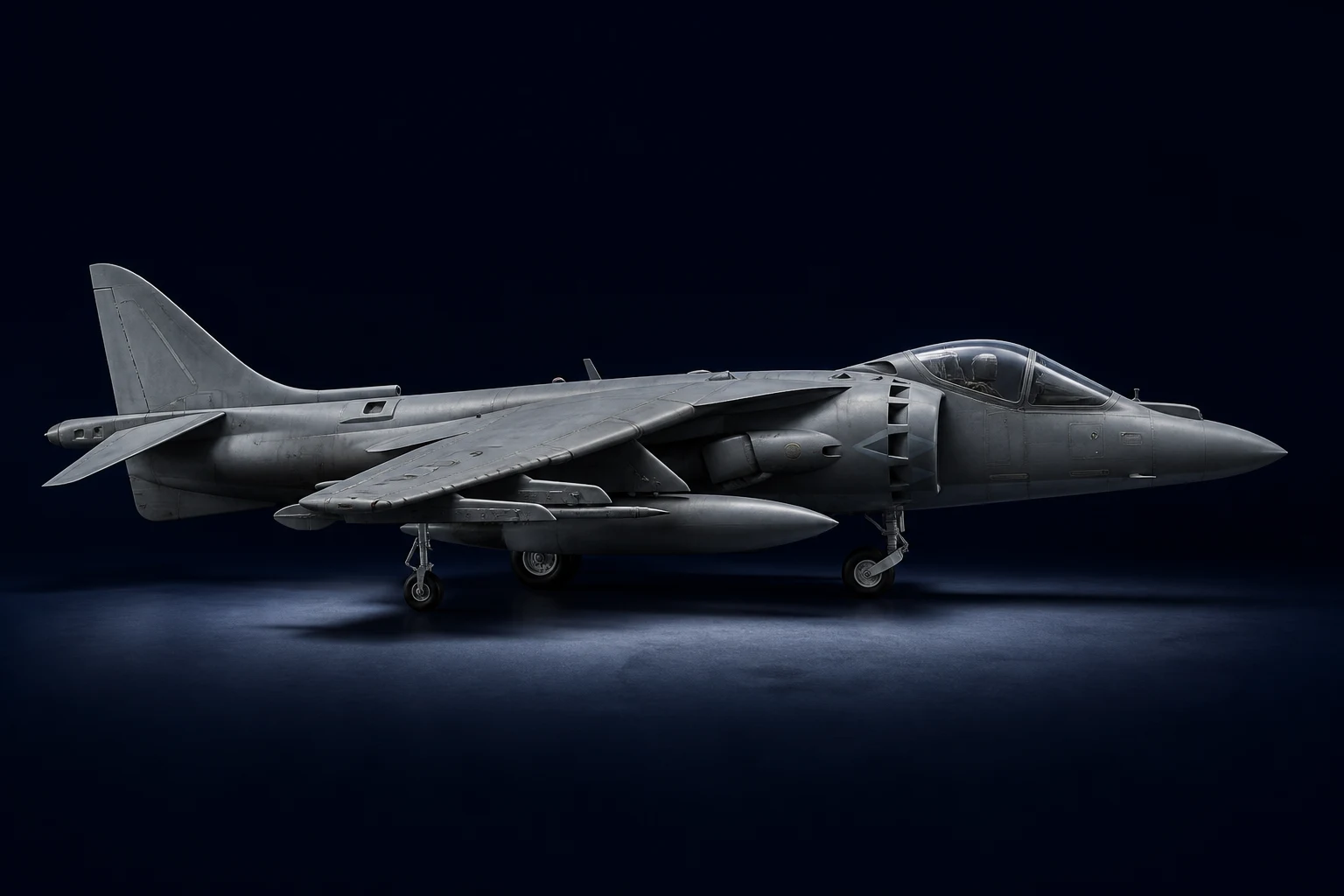
The Mammoth Hydra is the most disproportionate piece of hardware in Leonida. It's a single-seat vectored-thrust strike fighter - a jet that can take off vertically, hover in place, translate sideways, and then rotate its nozzles aft and accelerate to transonic speed. There is no civilian justification for any of that, which is exactly why it's the aircraft everyone wants.
The engineering behind it is genuinely remarkable. A single large turbofan feeds four rotating nozzles arranged around the aircraft's center of gravity, and the pilot controls their angle with a lever beside the throttle. Point them down and the airplane becomes a very loud, very unstable helicopter. Point them back and it becomes a fighter. The transition between those two states, done at the wrong altitude or the wrong airspeed, is how most Hydras are lost, and no amount of practice makes it feel entirely safe.
What that capability means in Leonida terms is that the Hydra is not constrained by the map. It doesn't need a runway, so a parking structure roof, a container stack at Port Gellhorn, a sandbar in the Keys, or a clearing in the Grassrivers are all viable operating bases. It can be somewhere it shouldn't be within minutes of leaving somewhere else it shouldn't be, and then it can leave again vertically, from a standing start, in any direction.
Officially, the type operates from Cape Verano Naval Air Station on the mainland coast and never enters civil airspace. Unofficially, Leonida's aviation authority has an entire filing category for reported Hydra sightings over places the Navy insists it does not fly, and the file is not thin.
Design
The Hydra's proportions are dictated entirely by the lift system. The fuselage is short and deep to accommodate the engine sitting amidships, the wing is a small high-mounted swept surface carrying outrigger landing gear at its tips, and the two main gear legs sit in tandem along the centerline - a bicycle arrangement that makes the aircraft look faintly precarious on the ground, because it is.
The four nozzles are the defining visual feature, projecting from the fuselage sides in two pairs and rotating in unison through roughly ninety-eight degrees. The forward pair exhausts cold bypass air, the aft pair hot core gas, and the scorch marks the hot pair leaves on any surface the aircraft hovers over are a permanent identifying feature of every unofficial Hydra landing site in Leonida.
The cockpit sits high and far forward under a bubble canopy with genuinely excellent visibility, which the aircraft needs because vertical landings are flown almost entirely by eye. The nose houses sensors; the intakes on either side of the cockpit are enormous, fitted with auxiliary suck-in doors that pop open at low speed. Standard finish is a low-visibility grey with minimal markings, and the reaction control puffers at the nose, tail, and wingtips - small jets that provide attitude control when there's no airflow over the surfaces - hiss audibly during a hover in a way that carries a surprising distance.
Performance
In forward flight the Hydra is a proper fighter. It accelerates hard, climbs steeply, and holds a transonic cruise that makes crossing the entire state a matter of minutes. It's not the fastest thing in Leonida airspace in a straight line, but it's fast enough that nothing without an interceptor's speed advantage will ever get a firing solution on it.
In the hover it becomes something else entirely - a heavy, twitchy, fuel-hungry machine balanced on a column of thrust, controlled by reaction jets and constant small corrections. Hover fuel burn is severe, hover stability degrades badly in gusty coastal conditions, and hot-and-high performance on a Leonida summer afternoon meaningfully reduces the weight the aircraft can lift vertically. Rolling takeoffs from any short stretch of straight road solve most of that and are what experienced pilots actually use.
The transition regime between wing-borne and jet-borne flight is where the aircraft is genuinely dangerous. Rotating the nozzles too aggressively at low airspeed drops the aircraft out of the sky; doing it too slowly at high airspeed overstresses the nozzle mechanism. Get the sequence right and the Hydra can decelerate from a high-speed pass to a stationary hover in a distance that looks physically impossible from the ground.
Driving & Gameplay
The Hydra removes terrain from the equation. Vertical takeoff means it operates from anywhere flat, jet speed means the entire map is minutes away, and the combination makes it the ultimate response to any objective that's difficult to reach. Anything involving offshore platforms, remote Grassrivers sites, or fortified compounds becomes a different problem when you can arrive from directly above and leave the same way.
It's also the hardest vehicle in the game to fly well, and that's deliberate. Vertical landings in a confined space demand real control precision, the transition regime punishes impatience, and fuel management in the hover means you cannot loiter the way a helicopter can. Players who put the practice in get an aircraft that does things nothing else can; players who don't get a very expensive crater.
Heat is the other cost. Flying a Hydra in Leonida airspace is not something the authorities absorb quietly - it draws a sustained and escalating response, and there's nowhere to land it that doesn't create a problem. The correct pattern is short, decisive sorties from a prepared site, not free-roam joyriding, however tempting that is.
Customization
There is no customization catalog in any conventional sense - the Hydra is not a product anyone sells you. What can be changed comes down to finish and fit. Paint options run to the standard low-visibility grey, a darker overwater scheme, and a handful of unmarked finishes favored by people who would prefer the aircraft not be traced to a specific inventory. Squadron markings and tail codes can be applied or, more commonly, stripped.
The functional changes are about range and signature. External fuel tanks on the inboard pylons dramatically extend an aircraft whose combat radius is otherwise modest, at the cost of hover performance. Sensor and countermeasure fits vary between airframes depending on what the previous operator specified. Nozzle-liner replacement is the one piece of maintenance that genuinely can't be improvised, which is why Hydras operating outside official channels have a limited and well-understood service life.
Locations
The Hydra's official home is Cape Verano Naval Air Station, the restricted coastal installation on the mainland west of Port Gellhorn. Aircraft sit on the covered line adjacent to the vertical-landing pads, and the whole facility is fenced, patrolled, and covered by air defenses that treat unidentified approaches as hostile by default.
A small detachment periodically stages out of the Gellhorn Reserve field for coastal exercises, which is the only time the type is regularly seen away from Cape Verano. Beyond that, the Hydra appears in Leonida wherever somebody has taken one - the scorched rooftop of a downtown Vice City parking structure, a cleared pad at a Keys estate, or a stretch of levee road on the Grassrivers rim, all of which have hosted an aircraft that was not supposed to be there.
In Leonida
Mammoth's vectored-thrust program began as a defense-contract oddity that most of the industry expected to fail. The idea of a jet that could operate from a clearing rather than a runway was compelling enough to keep funding alive through a long and unpromising development, and the resulting aircraft has spent its entire service life being simultaneously indispensable and slightly terrifying to the people who operate it.
In Leonida the type's history is mostly the history of its absences. Cape Verano's inventory reconciliations are not public, but the number of Hydra sightings logged by civil aviation over the Keys, the Grassrivers, and - on one memorable occasion - directly over the Vice City beach strip has produced a persistent regional belief that the Navy has lost track of at least one airframe. The official position is that all aircraft are accounted for. The scorch marks on a downtown parking structure roof have never been officially explained.
Trivia
- The scorch pattern left by the aft nozzles is distinctive enough that investigators can identify an unauthorized Hydra landing site months after the fact.
- Reaction-control puffers at the nose and wingtips hiss loudly enough during a hover that residents near unofficial landing sites report the sound before the engine noise.
- Rolling takeoffs are standard practice among experienced pilots because vertical lift performance falls off sharply in Leonida's summer heat.
- The bicycle-style main landing gear with wingtip outriggers makes the aircraft notoriously awkward to taxi in a crosswind.
- Civil aviation in Leonida maintains a dedicated reporting category for Hydra sightings in airspace the Navy states the type does not enter.