Aircraft
Buckingham Maverick
Buckingham · Light utility helicopter
- Seats
- 4
- Top speed
- ~120 knots / 138 mph
- Price
- ~$1,150,000
- Mass
- 1,450 kg
- Real-world inspiration
- Bell 206 JetRanger
- Availability
- Available for purchase from any Vice City charter dealer at a mid-tier aviation price, and easily taken from tour operator ramps, hospital pads, and rooftop helipads.
- Overview
- The single most common helicopter in Leonida - news, tourism, police, and everything that needs four seats and a rooftop.
Description
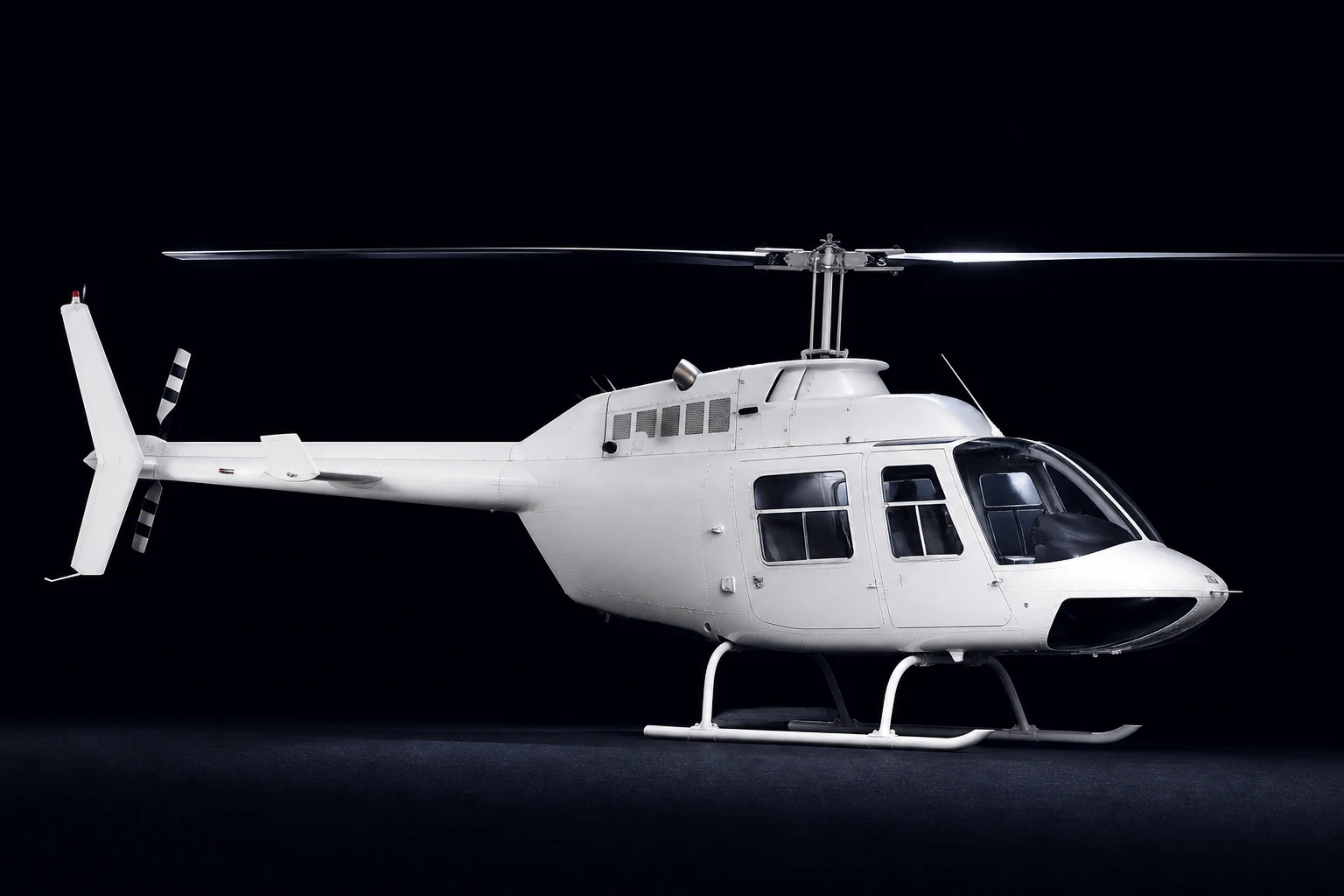
The Buckingham Maverick is the helicopter shape that lives in everyone's head. Bulbous nose, long tail boom, two-blade main rotor, skids instead of wheels - if you sketch a helicopter without thinking about it, you draw a Maverick. There are more of them in Leonida than every other rotorcraft type combined, and they do virtually every job that involves getting four people or a camera into the air.
Its dominance comes from being cheap to operate and almost impossible to break. The turbine is famously reliable, the airframe tolerates neglect, and the type's operating economics are good enough that flight schools, tour operators, traffic reporters, and charter companies can all make money with one. That ubiquity means parts are everywhere, mechanics who know the type are everywhere, and a Maverick sitting on a helipad attracts precisely no attention.
In Vice City the Maverick is the texture of the skyline. Tour flights run continuous circuits over the beach strip, news aircraft orbit anything interesting, corporate machines shuttle between rooftop pads downtown, and police units hold overhead whenever something goes wrong at street level. The distinctive two-blade rotor slap - a hard, flat percussive beat you feel as much as hear - is the ambient sound of the city having a bad afternoon.
For players it's the workhorse. It's not fast, it's not armored, and it carries nothing heavier than its passengers, but it's the aircraft you can find almost anywhere, fly almost anywhere, and land almost anywhere, and that combination makes it more useful than almost anything with better numbers.
Design
The Maverick's shape is functional and completely resolved. A rounded forward cabin with wraparound glazing gives the pilot and front passenger genuinely excellent visibility, including the chin windows that make precision landings on small pads possible. Behind them a rear bench seats two more, with a modest baggage compartment in the tail boom root.
The two-blade semi-rigid main rotor is the type's defining mechanical feature. It's simple, cheap, and durable, and it produces the characteristic slap under load along with a pronounced two-per-revolution vibration that every Maverick pilot simply stops noticing after a few dozen hours. The tail boom is a long, slim tube carrying a two-blade anti-torque rotor and a small horizontal stabilizer.
Skid gear keeps things light and simple, and it's why the type can put down on grass, sand, a rooftop, or a Grassrivers levee without any preparation. Cabin doors are wide and can be removed entirely - standard practice for camera work and for anyone who wants to shoot from the aircraft. Liveries in Leonida run the full spectrum: news station colors, tour-operator tropical schemes, corporate white, police blue and white, and the plain unmarked finishes that quietly indicate the operator would rather not be identified.
Performance
The numbers are modest and entirely adequate. Cruise sits at a genuine hundred and twenty knots, climb is unhurried, and range is enough to cross Leonida with a comfortable reserve. It's not fast enough to outrun anything determined, which is the type's single biggest limitation and the reason nobody uses one as a getaway vehicle if they have a choice.
Handling is where the Maverick earns its reputation. The two-blade rotor system is responsive and predictable, control forces are light, and the aircraft is stable enough to hand-fly precisely in a hover for extended periods - critical for camera work, rooftop pickups, and putting a skid on a boat deck. It's the easiest rotorcraft in Leonida to learn and one of the most satisfying to fly well.
Its weaknesses are load and exposure. Four seats and a small baggage bay is the hard limit, hot-and-humid Leonida conditions eat into available power noticeably, and the airframe offers no protection at all - the cabin is a glass bubble, and small-arms fire from the ground is a genuine threat at low altitude. The type's excellent autorotation characteristics mean an engine failure is survivable, which is more than can be said for the damage that usually causes one.
Driving & Gameplay
The Maverick is the general-purpose air answer for most of the game. It's easy to fly, easy to find, carries a full crew, and can land on any flat surface, which makes it the practical choice for the huge middle range of objectives - reaching a rooftop, extracting from an island, scouting a compound, crossing terrain that has no road.
It's the best surveillance platform available without going military. Removed doors let passengers shoot or observe, the search light and camera fits handle night work, and the aircraft is stable enough in a hover to hold a position over a target for as long as fuel allows. Nobody on the ground reacts to a helicopter orbiting Vice City, which means you can do this in plain sight in a way that would be impossible in anything armed.
Its vulnerability is the thing to plan around. It's slow, it's unarmored, and the cabin is glass. Approaching a hot objective in a Maverick means arriving before anyone is alert or arriving somewhere they're not looking - a beach, a rooftop on the wrong side, a Grassrivers clearing a kilometer out. Fly it like a taxi, not a gunship, and it'll do more work than anything else in the hangar.
Customization
Charter outfitters and rotorcraft shops offer an extensive practical catalog. Livery is the big one: news packages, tour-operator schemes, corporate finishes, medical markings, and a range of unmarked paints. Door configurations run from full glazing to camera doors to removed entirely, and the interior can be specified as four-seat standard, executive two-plus-two with leather, or stripped for utility work.
The functional additions are what make individual aircraft useful. A gimballed camera ball under the nose, a high-intensity search light on the skid crosstube, and a loudhailer are the surveillance package. A cargo hook, external litter kit, and skid-mounted panniers cover the utility side. Extended-range fuel, a night-vision-compatible cockpit lighting fit, and an exhaust suppressor that meaningfully reduces the type's acoustic signature are the options fitted by operators with less publicized business models.
Locations
Mavericks are everywhere in Leonida. Rooftop pads across downtown Vice City hold corporate and charter machines, the tour operators run continuous fleets off the pads near the beach strip, and Vice City International has a full rotorcraft ramp. Hospital pads, news station roofs, and hotel helidecks all keep one.
Beyond the city, Gellhorn Regional has a general aviation apron with several, the Keys resorts operate charter machines for guest transfers, and the Grassrivers park service and Mount Kalaga ranger stations both fly Mavericks for patrol and rescue work. Police units stage from municipal pads throughout the metro area. Finding one is never the problem; finding one that's fueled is occasionally more interesting.
In Leonida
Buckingham's light utility program produced an aircraft that outlived every projection made for it. The design was conservative even when new - two-blade rotor, single turbine, no complexity anywhere - and that conservatism turned out to be the entire reason for its success. Operators wanted something that flew every day and cost very little to keep flying, and the Maverick delivered that for decades while more sophisticated competitors came and went.
Leonida adopted it comprehensively. Tourism made the state one of the largest civil rotorcraft markets in the country, and the Maverick's operating economics meant it took essentially all of it. The type's role in local life is now so embedded that Vice City's traffic reporting, its beach tour industry, its hospital transfer network, and its police aviation unit all depend on the same basic airframe - a monoculture that Buckingham's competitors point out at every opportunity and that nobody in Leonida has any intention of fixing.
Trivia
- The two-blade rotor's distinctive slap is loud enough that Vice City residents can tell a Maverick from any other helicopter without looking up.
- Chin windows below the pilot's feet exist specifically for precision landings on small rooftop pads, and pilots who learn to use them can put a skid on a target the size of a car hood.
- Removing the cabin doors is a five-minute job and is standard for camera work - and for a number of activities that are not camera work.
- The type autorotates well enough that an engine failure over Vice City is considered survivable, provided you have somewhere flat within gliding distance.
- Tour operators along the beach strip fly circuits so regular that Keys residents set their watches by the overflights.