Utility & Service
Maibatsu Mule
Maibatsu · Medium box truck
- Seats
- 3
- Drivetrain
- RWD
- Top speed
- ~82 mph / 132 km/h
- Price
- ~$47,000
- Mass
- 6,400 kg
- Real-world inspiration
- Isuzu N-Series / Hino cab-over box trucks
- Availability
- Purchasable at a modest commercial price, and readily available from loading docks, rental yards, and the Port Gellhorn freight terminals.
- Overview
- The cab-over box truck that moves everything in Leonida that won't fit in a van and doesn't justify a semi.
Description
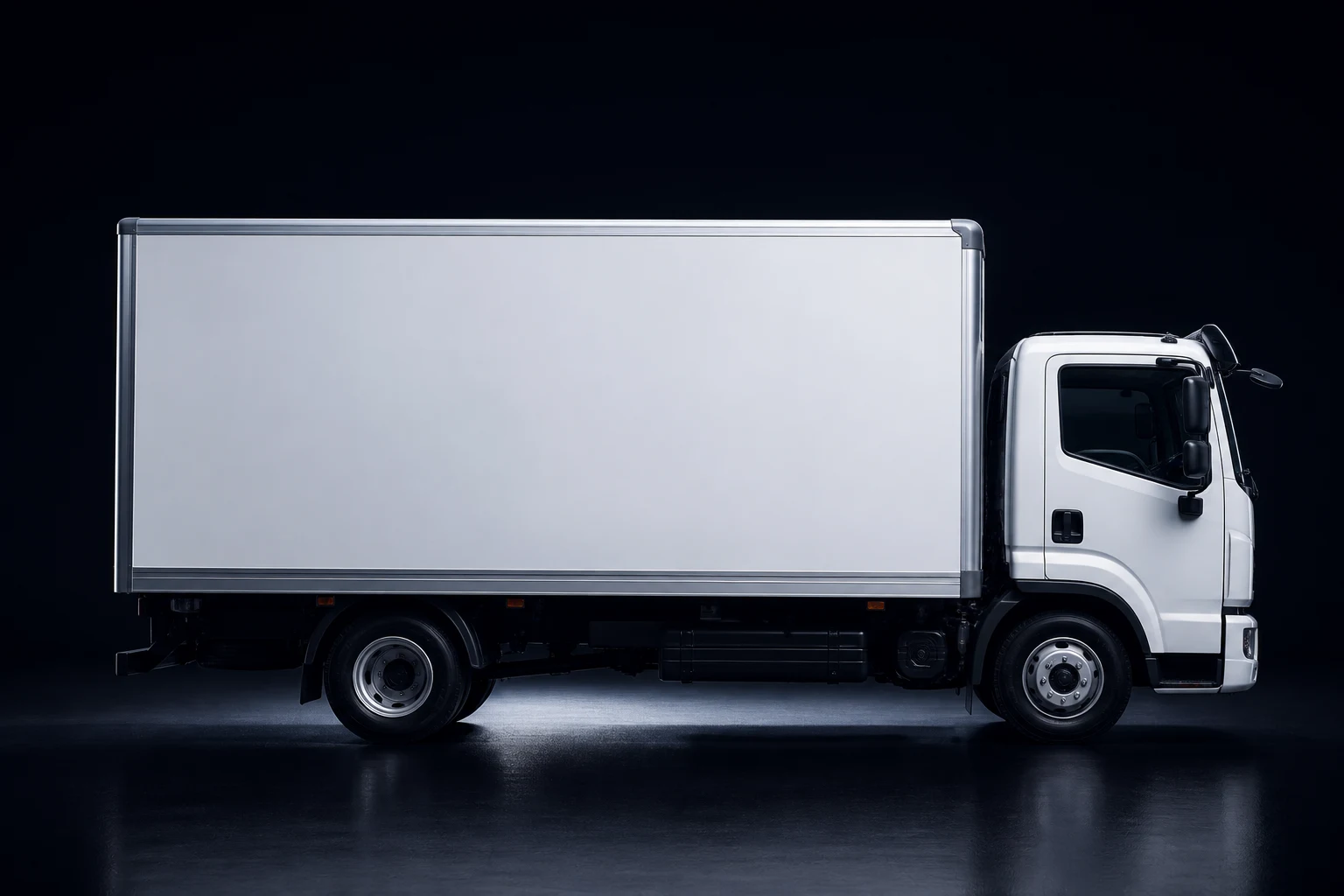
The Maibatsu Mule is the vehicle that keeps Leonida stocked. It's a medium-duty cab-over box truck - a flat-fronted cab sitting directly above the front axle, a diesel underneath it, and a rectangular cargo box behind that occupies most of the vehicle's length. Every retail delivery, every furniture move, every restaurant supply run, and a substantial share of the state's less documented freight happens in one.
The cab-over layout is the whole engineering argument. Putting the driver above the engine instead of behind it means a shorter wheelbase for the same cargo length, a tighter turning circle, and a truck that can actually work in a city built around narrow service alleys and cramped loading docks. It also means the driver sits high, sees everything ahead, and has essentially no crumple structure in front of them, which is a tradeoff the industry made a long time ago and has never revisited.
The cargo box is where the value is. It's tall enough to stand in, long enough for serious volume, closed and lockable, and - critically - completely opaque. A Mule pulled up to a loading dock with the roller door halfway open is the most normal sight in Leonida commerce, and what goes in and out of it is nobody's concern as long as the paperwork on the clipboard looks approximately correct.
For players it's the step up from the Speedo: much more capacity, much more presence, and a much longer list of things it can plausibly be doing anywhere in the state. It's also slow, ponderous, and impossible to hide, which makes it a vehicle you commit to rather than one you improvise with.
Design
The Mule is two boxes bolted together and makes no attempt to disguise it. The cab is a flat-fronted cube with a large windscreen, a shallow grille, and steps up to doors that open almost ninety degrees - necessary, because entering the cab is a genuine climb. The whole cab tilts forward on a hinge for engine access, which is the only way to reach anything mechanical.
Inside, three across on a bench with the engine tunnel between the driver and the center position, a near-vertical steering wheel, and a dashboard laid out for durability. Visibility forward and down is exceptional; visibility rearward depends entirely on the mirrors, which are enormous and still not enough. The seating position is high enough that a Mule driver can see over most traffic in Vice City, which is one of the job's few genuine perks.
Behind the cab, the box is an aluminum-skinned structure on a steel subframe, with a roller shutter at the rear, a hydraulic tail lift on most examples, and a side door on some. Fleet operators cover the sides in livery, which makes the Mule the largest mobile advertising surface in the state and, conveniently, the easiest vehicle to make look like it belongs to a business that exists.
Performance
The Mule is slow, and loaded it is very slow. The diesel produces torque rather than speed, the transmission has more gears than anyone enjoys using, and the top speed is limited both by gearing and by the fact that a loaded box truck at eighty miles an hour is a bad idea everyone involved understands. Getting up to speed on the causeway takes planning; getting up the grades toward Mount Kalaga takes patience.
Handling is dominated by mass and height. The box catches crosswinds badly on exposed coastal roads, the center of gravity is high enough that hard cornering is genuinely dangerous, and the turning circle - while excellent for the vehicle's length - still requires thinking two moves ahead in tight streets. Reversing to a dock is a skill, and the game treats it as one.
Braking is the number that matters most. Six-plus tons loaded takes serious distance to stop, and the brakes fade on long descents in a way that punishes drivers who ride them. Where the Mule wins is presence and durability: it goes through obstacles rather than around them, it barely notices contact with normal traffic, and roadblocks made of passenger cars are not really roadblocks when you're driving one.
Driving & Gameplay
The Mule is the cargo answer. When the job involves volume - a lot of product, a lot of equipment, or something physically large - this is the vehicle the mission is designed around, and there's no substitute for the box. Its capacity, its lockable cargo area, and its total normality around commercial districts make it the backbone of any operation that involves moving quantity.
It's also a rolling piece of set dressing. A liveried Mule backed up to a dock, a warehouse, or a service entrance is an event so mundane that it generates no reaction at all, which lets you occupy a location openly for as long as the loading plausibly takes. Missions that involve infiltrating commercial premises frequently hinge on exactly this, and the game rewards the players who think about which livery fits where.
What it cannot do is leave in a hurry. The Mule accelerates poorly, brakes worse, and corners like a building. Once a plan involving one goes loud, the truck is no longer transport - it's cover, a roadblock, or a very large distraction. Sensible crews bring a second vehicle, and the ones who don't learn why at about forty miles an hour with the cargo shifting.
Customization
Livery is the primary customization and the most useful one. Full-side wraps for grocery, furniture, appliance, beverage, courier, and moving companies are all available, along with plain white boxes and the rental-fleet schemes that make a truck look like it belongs to somebody doing exactly what everyone assumes they're doing. Fleet numbers and door decals complete the effect.
Functionally, the important options are on the box. A hydraulic tail lift, interior shelving and load rails, a refrigeration unit with the roof pod and side vents that go with it, and reinforced side panels that make the cargo area meaningfully harder to open from outside. Curtain-side conversions trade security for loading speed. Cab options are limited but practical - auxiliary lighting, a roof-mounted beacon, a heavier bumper, and an air-conditioning upgrade that in the Leonida climate is fitted to essentially everything.
Locations
Mules cluster around commerce. The distribution centers in the Vice City industrial belt run fleets of them, every shopping center and supermarket has one at the loading dock in the mornings, and the furniture and appliance retailers keep them lined up out back. Rental yards along the highway approaches stock dozens.
Port Gellhorn is the densest concentration - the freight terminals there use Mules for everything that comes out of a container and doesn't justify a full semi load, and the yards are full of them at all hours. Beyond that, they run the causeway to the Keys daily supplying the resorts and restaurants, and the agricultural operations west of the Grassrivers use older examples for produce hauling right up until the frames rust through.
In Leonida
Maibatsu's medium-duty line was built for dense Asian cities where a conventional-cab truck simply couldn't turn into the streets it needed to serve, and the cab-over layout that resulted turned out to translate perfectly to older American downtowns with the same problem. The trucks arrived cheap, reliable, and easy to service, and the domestic manufacturers spent a decade insisting the market didn't want them before conceding that it did.
In Leonida the Mule took over the last-mile freight business almost completely. Vice City's service alleys, the Keys' narrow resort access roads, and the tight yards at Port Gellhorn all favor a truck that turns tightly and loads high, and the economics - low purchase price, cheap parts, a driveline that tolerates decades of abuse - did the rest. The state's freight sector now runs on a vehicle designed for cities on the other side of the world, and nobody involved finds this remarkable.
Trivia
- The entire cab tilts forward on a hinge for engine access, a process that takes two people and a great deal of profanity if the truck is parked on a slope.
- Its turning circle is tighter than some full-size pickups despite being twice the length, which is the single reason it dominates Vice City alley deliveries.
- The box sides are the largest mobile advertising surface in Leonida, and sign shops charge accordingly.
- Refrigerated examples are identifiable at a distance by the roof pod, and are noticeably slower because the unit runs off the engine.
- Older Mules doing produce work west of the Grassrivers routinely stay in service until the subframe rusts through, at which point the box is lifted onto a newer chassis and continues.