Utility & Service
Jobuilt Phantom
Jobuilt · Semi tractor
- Seats
- 2
- Drivetrain
- 6x4
- Top speed
- ~90 mph / 145 km/h
- Price
- ~$110,000
- Mass
- 9,800 kg
- Real-world inspiration
- Peterbilt 379 / conventional long-nose American semi tractors
- Availability
- Purchasable at a high commercial price, and available to take from truck stops, port yards, and distribution centers - though a tractor without a trailer is only half of what you probably came for.
- Overview
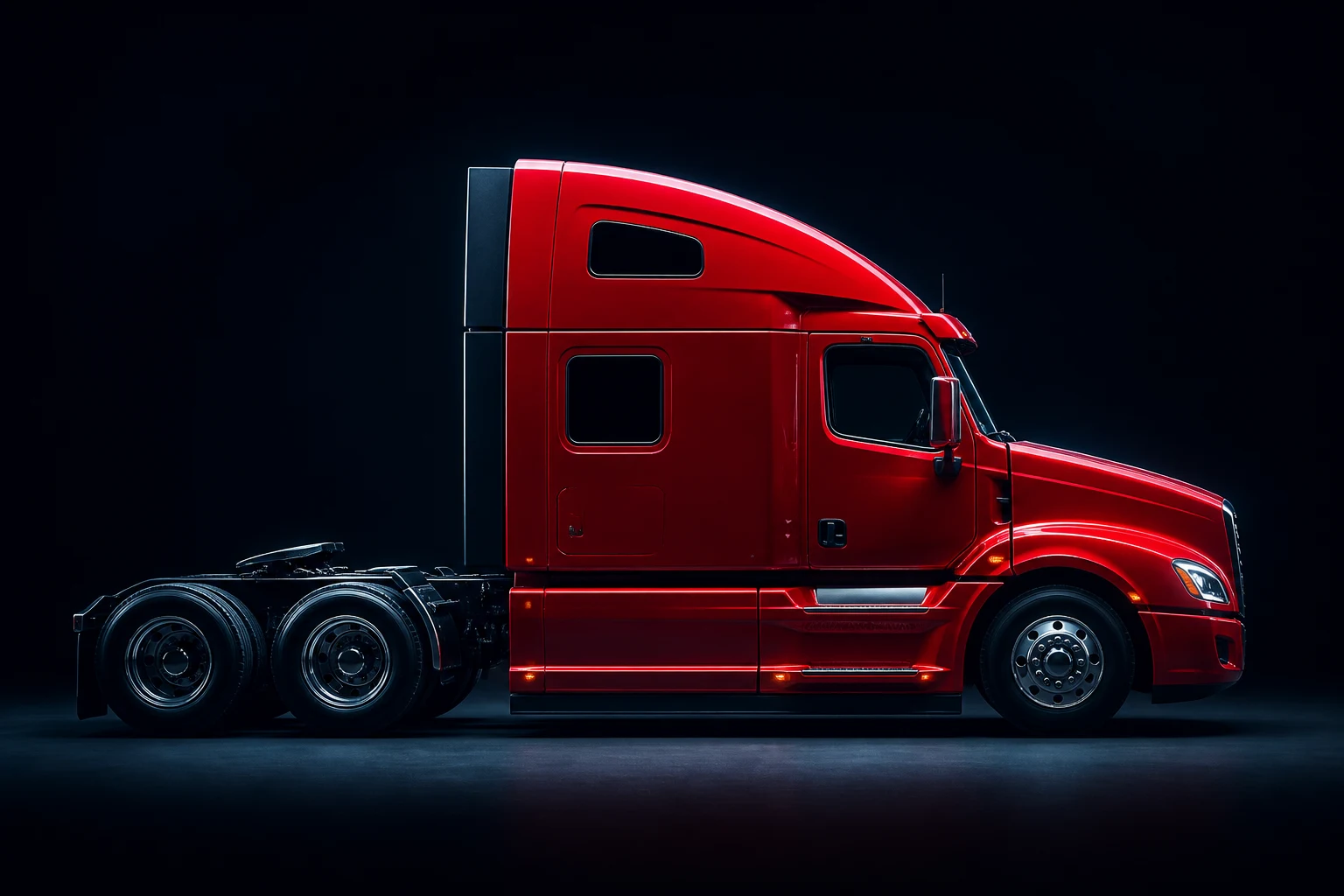
- A long-nose conventional semi tractor with a sleeper and a chrome habit - the biggest thing you can legally drive in Leonida.
Description
The Jobuilt Phantom is a proper American conventional semi tractor: a long chromed hood over a big diesel, a sleeper cab behind it, a fifth wheel over the rear tandem, and enough torque to move anything the state produces. It is the largest and heaviest vehicle in normal Leonida traffic, and driving one changes your relationship with the road in a way nothing else does.
Its world is the highway corridor between Port Gellhorn and Vice City, the container yards at the port, and the long agricultural hauls out of the country west of the Grassrivers. A Phantom with a trailer is a working unit; a Phantom without one - a bobtail - is a strange, twitchy, oddly quick machine that handles nothing like it looks and is the way most drivers actually get to and from a load.
The conventional layout is a cultural choice as much as an engineering one. Cab-over tractors are shorter and more maneuverable, but American owner-operators want a long hood, a big chrome grille, and a sleeper they can live in, and Jobuilt has built exactly that for as long as anyone can remember. A well-kept Phantom at a truck stop with polished stacks and a lit-up trim package is a genuine object of pride, and its owner will tell you about it.
For the game, the Phantom is what makes trailer content possible. Container heists, tanker jobs, car-carrier work, and anything involving moving something enormous across the state all require a tractor, and this is the tractor. It's slow, it's massive, and reversing a trailer with it is a genuine skill - which is precisely why doing it well feels like something.
Design
The Phantom is built around its hood. A long, square-shouldered bonnet runs forward from the windscreen to a tall vertical chrome grille flanked by round headlamps, with polished fenders over the steer axle and a set of vertical exhaust stacks rising behind the cab. Air horns sit on the roof. None of this is aerodynamically defensible and all of it is the point.
The cab seats two on air-suspended seats, with a genuinely usable sleeper compartment behind - a bunk, storage lockers, a small refrigerator on well-specified trucks, and curtains between the sleeper and the driving position. Owner-operators fit them out extensively, and the difference between a fleet Phantom and a privately owned one is visible the moment the door opens.
Behind the cab sits the fifth wheel plate on a slidable mount, the air and electrical lines that connect to the trailer, and the rear tandem - two driven axles with eight wheels, dual-tired, on air suspension. Fuel tanks are polished aluminum cylinders slung between the axles. Standard finishes run to solid fleet colors, but the trucks that matter wear deep metallics, hand-applied pinstriping, and enough chrome to be genuinely hazardous to look at in Leonida sun.
Performance
Bobtail - without a trailer - the Phantom is startling. Nine tons with a very large engine and no load means it accelerates hard, revs freely, and will reach speeds that feel deeply inappropriate. It also handles badly in that state: the rear tandem is unloaded, traction is poor, and the back end will step out under braking in a way that surprises everyone who tries it once.
With a trailer attached it becomes a different vehicle entirely. Acceleration is glacial, the transmission requires constant work, and the combination is limited by how quickly it can be brought back down to a stop - which is not quickly. Braking distances with a loaded trailer are enormous, the brakes fade on long descents, and jackknifing is a real and easily achieved outcome for anyone who brakes hard mid-corner.
What it delivers is unstoppability. A loaded Phantom simply does not care about other vehicles, barriers, or most road furniture, and using one to force a way through a blocked highway is entirely viable. Its weaknesses are turning circle, reversing, and the fact that it cannot leave the road network - a Phantom on soft ground is a Phantom that stays there.
Driving & Gameplay
The Phantom exists to pull trailers, and the trailer is the mission. Container work out of Port Gellhorn, tanker jobs, car-carrier hijacks, and any objective involving cargo too large for a box truck all run through this vehicle, and the game's heaviest logistics content is built on it. Coupling, hauling, and dropping a trailer are mechanics in their own right.
As a weapon it's unmatched in a specific way. Nothing in traffic can stop a loaded combination, roadblocks are suggestions, and using a Phantom to physically remove a pursuing vehicle from the road is both effective and extremely satisfying. Missions that call for blocking a route, ramming a convoy, or breaching a gate frequently point you at one for exactly that reason.
The skill ceiling is in the handling. Reversing a trailer, taking a Vice City intersection without climbing the curb, and managing speed on a descent are all genuinely difficult and genuinely learnable, and the game doesn't simplify them. Players who put the time in can do things with a Phantom that look impossible; players who don't will spend a lot of time jackknifed across three lanes.
Customization
The Phantom has the most indulgent customization catalog of any working vehicle in Leonida because owner-operators treat their trucks as personal projects. Chrome is the core of it: bumpers, grille surrounds, stack shields, fender trim, wheel covers, air cleaners, and light bars along the roof and the cab sides. Deep metallic paints, hand pinstriping, and custom mudflap graphics complete the look.
Functional options run to sleeper configurations from a basic bunk to a full living fit, exhaust stack heights and styles, fifth-wheel positioning, auxiliary fuel capacity for long hauls, and heavier bumpers and grille guards for trucks that work rural routes where wildlife is a genuine hazard. Fleet operators skip all of it and specify plain paint, steel wheels, and the cheapest sleeper available, which is how you can tell at a glance whether the truck belongs to the person driving it.
Locations
The Phantom lives on the freight network. Port Gellhorn is the center of it - the container terminals there keep dozens in the yards at any hour, hooked, dropped, and idling. The truck stops along the interstate corridor between Gellhorn and Vice City hold rows of them overnight, and the industrial belt distribution centers have them backed to the docks around the clock.
Outside the freight world they turn up wherever heavy things need moving: agricultural yards west of the Grassrivers during harvest, construction staging areas around the city's larger projects, and the equipment yards serving the causeway maintenance work. You'll also find them abandoned on highway shoulders with the hazards on, which is either a breakdown or the least interesting part of a much longer story.
In Leonida
Jobuilt's heavy truck division has built the same basic conventional tractor for decades, updating the driveline and the cab interior while refusing to touch the long-hood proportions that define it. The company's reasoning is straightforward: its customers are owner-operators who buy on emotion as much as economics, and the day Jobuilt shortens the hood is the day they buy something else.
Leonida's freight economy grew around Port Gellhorn, and the Phantom grew with it. The corridor between the port and Vice City is one of the busiest freight routes in the region, and the truck-stop culture along it - the informal hierarchies, the chrome, the paint, the trucks that families have owned across two generations - is a genuine subculture with its own economy. It's also, unavoidably, the route by which a great deal of the state's less official commerce travels, and the port's inspection statistics are a subject nobody at the terminal enjoys discussing.
Trivia
- Bobtail - without a trailer - the Phantom is quick enough and unstable enough that most of the truck's spectacular accidents happen when it's empty.
- The vertical exhaust stacks are aerodynamically indefensible and are the first thing owner-operators spend money on.
- A well-specified sleeper includes a refrigerator, which is the single most argued-over option in the entire Leonida trucking community.
- The fifth wheel slides fore and aft to adjust axle loading, a detail that matters enormously at a weigh station and not at all to anyone avoiding one.
- You can tell a fleet truck from an owner-operator's at a hundred yards purely by the amount of chrome, and everyone at the truck stop already has.