Utility & Service
Vapid Taxi
Vapid · Fleet sedan
- Seats
- 4
- Drivetrain
- RWD
- Top speed
- ~112 mph / 180 km/h
- Price
- ~$21,000
- Mass
- 1,850 kg
- Real-world inspiration
- Ford Crown Victoria / body-on-frame American fleet sedans
- Availability
- Available immediately and everywhere in Vice City. Hail one, take one from a rank, or lift one from a fleet depot between shifts.
- Overview
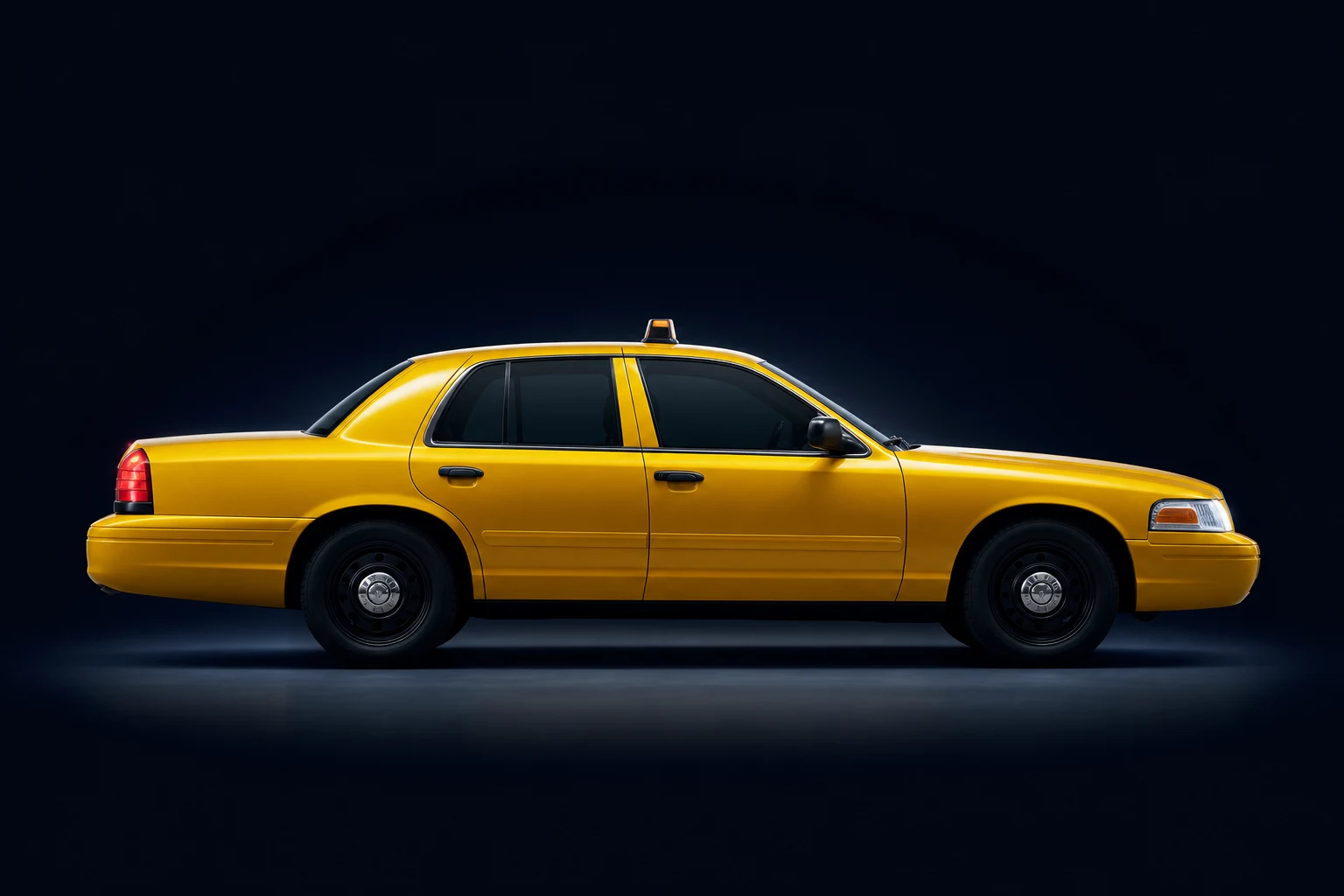
- A yellow body-on-frame fleet sedan with a partition and a light on the roof - Vice City's most invisible vehicle and its best source of information.
Description
The Vapid Taxi is a body-on-frame full-size sedan in yellow paint with a roof light, a partition behind the front seats, and four hundred thousand miles on the clock. It is not a good car by any modern standard, and it is possibly the best-suited vehicle in Leonida to the actual work of getting around Vice City without anyone caring who you are.
The platform is ancient and that's exactly why it's used. A separate frame, a live rear axle, and a big lazy V8 make a car that's cheap to fix, tolerant of potholes and curbs, and capable of running twenty hours a day for years. Fleet operators buy them used from other fleets, run them until the frame gives up, and then sell the drivetrain to somebody who'll get another decade out of it.
What makes the Taxi genuinely valuable is where it can go. A cab can idle outside a hotel, sit at a rank across from an office tower, cruise a residential street at 3 a.m., or pull up to any address in the city, and none of those things is worth a second look. There is no other vehicle in Leonida with that range of legitimate presence, which is why surveillance operations, both official and otherwise, have relied on the yellow sedan for as long as anyone can remember.
And then there's the back seat, which is the real product. People say things in cabs that they would not say anywhere else, on the assumption that the driver is scenery. In Vice City that assumption is frequently wrong, and a substantial amount of what the city knows about itself travels through the front seat of a Taxi at some point.
Design
The bodywork is generic full-size sedan from a decade nobody remembers fondly - a long hood, a formal roofline, a big trunk, and rectangular headlamps in a plain grille. It's not attractive and it was never trying to be. The proportions exist because a body-on-frame platform with a longitudinal V8 has to look like this.
The taxi conversion is what defines it. A roof-mounted illuminated sign, a meter on the dashboard, a plexiglass partition behind the front seats with a sliding payment tray, hard-wearing vinyl rear seating chosen for how easily it cleans, and a rear compartment with no interior door handles on some fleet specifications. The trunk is enormous and typically holds a spare, a jack, and whatever the last four passengers forgot.
The finish is yellow - the specific fleet yellow that fades unevenly, with checker decals along the flanks, a fleet number on the doors and roof, and a licensing sticker in the rear window. Every Taxi in Vice City carries the same accumulated evidence of use: mismatched hubcaps, a cracked bumper cover, a suspension corner that sits slightly lower than the others, and a windscreen with a chip somebody meant to deal with.
Performance
The Taxi is more capable than it looks, which is the whole charm of the platform. The V8 is unstressed and torquey, the car pulls smoothly to genuinely respectable speeds, and the body-on-frame construction handles curbs, potholes, and low-speed collisions with a shrug. It's not fast, but it's never as slow as anyone expects.
Handling is soft, floaty, and entirely predictable. It leans hard, understeers into corners, and then oversteers cheerfully if you provoke it, all in slow motion. The steering is numb and the brakes are adequate at best. Drivers who learn its rhythm can throw a Taxi around Vice City with real speed; drivers who fight it will be sliding through intersections sideways.
Durability is its genuine strength. The frame absorbs impacts that would end a unibody car, the suspension survives abuse, and the mechanical simplicity means a damaged Taxi usually keeps running. It's also heavier than most traffic, which makes it more useful in a shunt than its performance figures suggest. Wet roads are its weakness - a live rear axle, worn tires, and a Leonida afternoon thunderstorm are a combination every cab driver in the city has a story about.
Driving & Gameplay
The Taxi is a movement tool and a social one. It can drive anywhere in Vice City without generating suspicion, park anywhere for a plausible reason, and approach any address without anyone wondering why - which makes it the best surveillance and approach vehicle in the urban half of the map. Missions built around observation, tailing, or arriving somewhere unannounced consistently favor it.
It's also a content vehicle in its own right. Picking up fares turns the whole city into a source of small stories, and the passengers who get in the back are a running thread of overheard conversations, bad decisions, and occasional leads that go somewhere. It's the closest the game gets to letting you just exist in Vice City for a while.
As a getaway car it's better than it should be. It's durable, it's heavy enough to push through traffic, and - critically - it looks exactly like the two hundred other yellow sedans in the surrounding blocks, which makes breaking line of sight genuinely effective. A tuned Taxi is one of the best sleepers in Leonida for precisely this reason: the pursuit is looking for the car that ran, and every cab in the district matches the description.
Customization
Customization is deliberately narrow and mostly about identity. You can change fleet livery between the several cab companies operating in Vice City, adjust roof sign styles, apply or remove checker decals and fleet numbering, and specify the amount of visible wear - from a nearly new fleet car to something that has clearly been in service since before the current management.
The substantive options are functional. The partition can be specified as full, half, or removed entirely, and the rear door handles can be disabled - a fleet safety feature with obvious other applications. Beyond that: a working meter, a roof-mounted advertising box, a radio setup, a dashboard camera, and, from the right shop, a suspension and brake package plus an engine tune that keeps the car's appearance identical while making it considerably quicker than anything wearing that paint has any right to be.
Locations
Taxis are constant in Vice City. Ranks outside the hotels along the beach strip, queues at the airport arrivals curb, cars circulating through downtown at all hours, and clusters outside the nightlife districts when the bars empty. There is no time of day when you cannot find one within a block or two in the urban core.
Outside the city they thin out fast. Gellhorn Regional has a small rank, the Keys resorts run a handful for guest transfers, and beyond that the yellow cab is essentially an urban species. The fleet depots on the edge of the industrial belt are where they live between shifts, parked in rows with the keys in the office, which is the most efficient place in the state to acquire one.
In Leonida
Vapid's body-on-frame full-size sedan was designed for fleet buyers and has never been sold to anyone else in meaningful numbers. Police departments, taxi operators, and government motor pools bought them by the tens of thousands because they were cheap, durable, and easy to fix, and the platform survived for decades past the point where the rest of the industry had moved to unibody construction, entirely on the strength of those three arguments.
In Vice City the cab fleet became a permanent feature of the city's fabric and, informally, part of its nervous system. Drivers know the streets, the buildings, the doormen, and the patterns, and the industry's structure - independent operators leasing medallions from companies that lease them from other companies - has always made it a difficult sector to see into from outside. Every account of how the city really works includes a cab driver at some point, and every one of them is driving the same yellow sedan.
Trivia
- The rear door handles can be disabled from the factory as a fleet safety feature, a specification with a number of applications the manufacturer does not advertise.
- Vice City cab drivers can identify which company a passing Taxi belongs to by the roof sign alone, at night, at distance.
- The trunk is large enough that it is the standard unit of measurement in Vice City for whether something will fit in a car.
- A tuned Taxi is among the best sleepers in Leonida - identical paint, identical roof sign, and a drivetrain that makes it faster than most of the traffic chasing it.
- Fleet depots park them in rows with the keys held in the office, an arrangement that works perfectly right up until it doesn't.