Boats & Seaplanes
Lampadati Toro
Lampadati · Luxury runabout
- Seats
- 4
- Top speed
- ~70 knots / 81 mph
- Price
- ~$1,850,000
- Mass
- 5,400 kg
- Real-world inspiration
- Riva Aquariva / Italian mahogany luxury runabouts
- Availability
- Purchase from the Vice City luxury brokerage at the very top of the marine price list, or take one from a private estate dock and accept that you now own the most identifiable boat in Leonida.
- Overview
- Hand-built Italian mahogany and chrome with a hidden turn of speed - the most expensive way to arrive at a Vice City dock.
Description
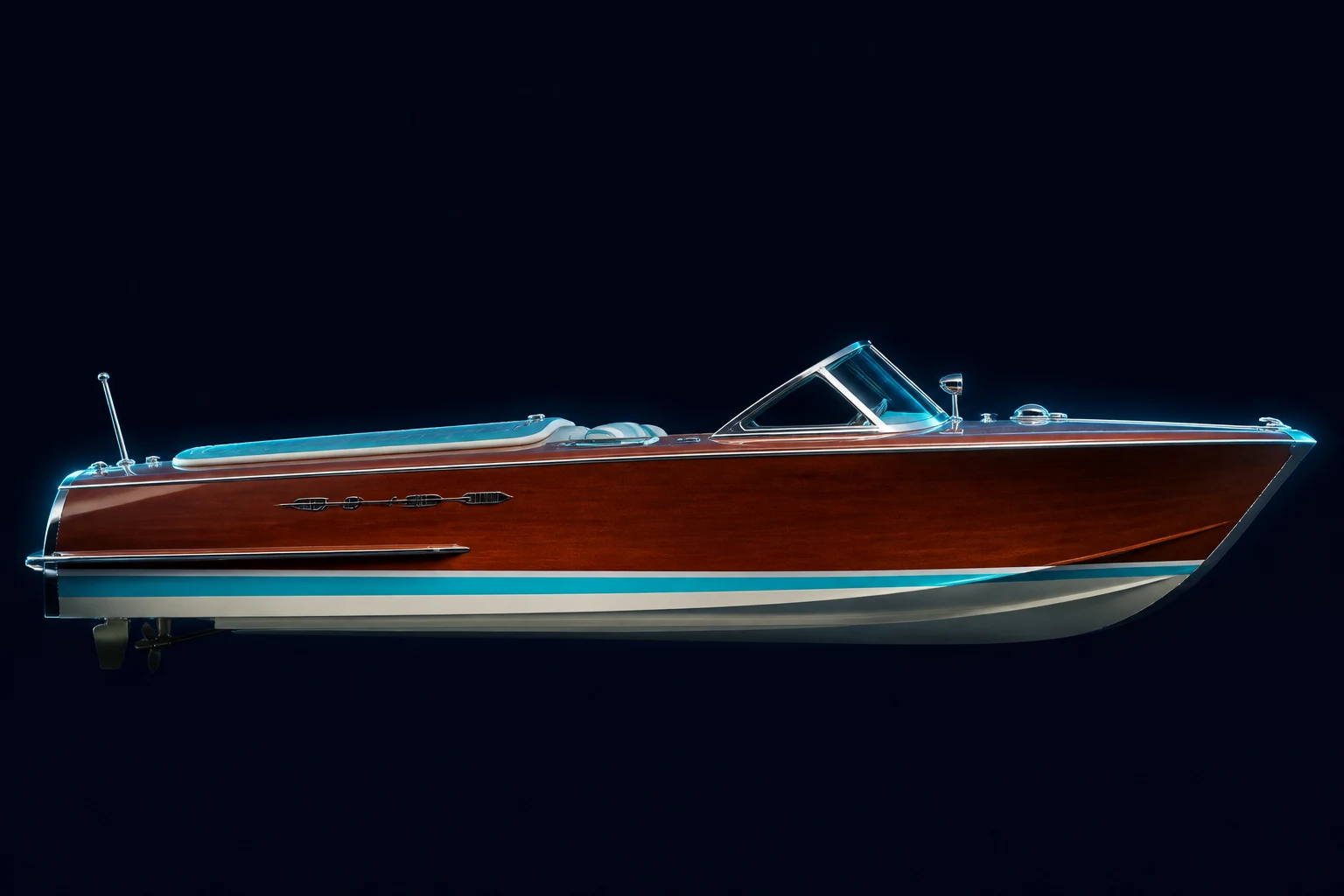
The Lampadati Toro is not really a boat, in the sense that boats are things you buy to accomplish tasks. It's a piece of furniture that happens to float, built by hand out of laminated mahogany and polished chrome by a yard in northern Italy that has been making essentially the same object for three generations, and it costs more than most of the houses it ties up in front of.
What separates it from being purely decorative is that it's genuinely fast. Under the varnished decking sits a serious twin-engine package, and the Toro will run away from almost anything on the water that isn't a dedicated offshore hull. That combination - antique-looking craftsmanship and modern performance - is the whole proposition, and it's why the boat has such a specific hold on Vice City's marina culture.
The Toro's owners are not, as a rule, subtle people, and the boat isn't a subtle object. It arrives at a dock the way a hand-built exotic arrives at a hotel entrance: slowly, loudly, and with everyone watching. In a city where visible wealth is the local currency, that's a feature, and the Toro sits at the very top of the informal Vice City status ladder for anything smaller than a yacht.
As a practical vehicle it's absurd. It's fast, comfortable, beautiful, wildly conspicuous, catastrophically expensive to repair, and completely unsuited to anything resembling actual work. It's the boat you buy when you've already bought everything else.
Design
The hull is laminated mahogany over a modern composite core, finished in enough coats of varnish to produce a mirror. The deck is planked in alternating light and dark timber with white seam lines running the full length of the boat, and every fitting - cleats, rails, windscreen frame, engine hatch hinges, throttle levers - is polished chrome. The effect in Leonida sunlight is genuinely difficult to look at directly.
The cockpit seats four in cream leather across two rows, with a bench aft and a pair of buckets forward, all trimmed with hand-stitched piping. The helm is a chrome-rimmed wheel and a bank of white-faced analog gauges, and the dashboard is a single unbroken panel of matched timber. There's a sun pad over the engine bay aft and a small forward locker, and that is the complete inventory of practical space aboard.
The styling language is entirely mid-century: a low sheer, a gentle tumblehome at the transom, a wraparound windscreen with a chrome center post, and a swept bow that flares slightly at the stem. Lampadati offers hull colors, but almost every Toro in Leonida is delivered in natural varnished timber with a white or pale blue boot stripe, because that's the correct answer and everyone knows it.
Performance
The Toro is deceptively quick. The twin-engine package gets a heavy hull onto plane smoothly and then keeps pulling well past the point where the boat's appearance suggests it should stop, running into the high sixties in knots with the kind of unhurried composure that makes the speed hard to judge from aboard.
Ride quality is the best in the catalog. The heavy laminated hull damps chop that would rattle a lightweight sport boat, and the long waterline keeps it tracking straight and stable at cruise. It corners with a graceful, deliberate lean rather than the snap of a smaller runabout - you plan turns in a Toro rather than making them.
Its limitations are cost and conspicuousness rather than capability. The hull draws more than the sport boats, ruling out the shallowest Keys and Grassrivers routes, and there is nothing anonymous about it under any circumstances. Damage is the real deterrent: the timber construction is beautiful and expensive, and even minor contact produces repair bills that make the whole exercise feel considerably less charming.
Driving & Gameplay
Functionally, the Toro is a fast four-seat boat with excellent ride quality, which makes it a genuinely capable coastal transport for a full crew. It will cross open water faster and more comfortably than anything else that carries four people, and for long runs between Vice City, the Keys, and Port Gellhorn it's the best travel experience in the marine catalog.
Its real role, though, is social. Missions involving parties, meetings with people who need to be impressed, and any scenario where the objective is credibility rather than stealth are all improved by arriving in a Toro. Showing up to a Keys estate dock in a hand-built mahogany runabout does more work than any amount of dialogue, and the game's coastal high-society content is designed with exactly that in mind.
As an operational tool it's a liability. It's the most recognizable boat in Leonida, it can't reach the shallow water where the useful escapes are, and every scratch costs a fortune. Own one, enjoy one, and take something disposable when the plan involves being chased.
Customization
Customization on a Toro is closer to commissioning than shopping. The timber finish can be specified in a range of natural stains from pale honey to near-black walnut, the deck seam lines in white, black, or contrasting timber, and the leather in the full range of Lampadati's automotive hide catalog with matched or contrasting piping.
The hardware options are all about metal. Full chrome, brushed nickel, or gold-plated fittings are offered, along with a chrome radar arch, period-correct navigation lamps, and a monogrammed transom plate that Lampadati will engrave with whatever the buyer requests. Mechanically, the only meaningful choice is the engine package - a higher-output option that adds real speed and a considerably more assertive note, chosen by essentially every buyer in Leonida despite the yard's polite suggestion that the standard fit is more appropriate to the boat's character.
Locations
The Toro exists in a very small number of very specific places. The private yacht basins on the north side of the Vice City marina district hold most of them, usually tied stern-to in the covered slips where the varnish is out of the sun. The waterfront of the beach strip's grand hotels keeps a few for guest use, and the private docks of the largest Keys estates account for most of the rest.
Occasionally one appears somewhere it shouldn't - moored off a sandbar during a party, tied at a Grassrivers fish camp for reasons nobody explains, or sitting at a Port Gellhorn commercial dock looking as out of place as it's possible for an object to look. These are the interesting ones, and they're almost always unattended.
In Leonida
Lampadati's marine yard predates its automotive business and has never scaled up, producing a few dozen hulls a year using construction methods that have barely changed in half a century. The company treats the boats as brand artifacts rather than products - they lose money on every one and consider the arrangement a bargain, because a Toro sitting at a dock does more for Lampadati's image than an entire advertising budget.
The boat's Leonida story is the story of the Vice City marina district. As the waterfront redeveloped and the money moved in, the Toro became the object that signaled you had arrived rather than merely appeared, and the waiting list for delivery stretched into years. That scarcity produced its own economy: used hulls trade above list, brokers maintain quiet lists of who might be persuaded to sell, and the provenance of an individual boat - who owned it, which dock it lived at, what it was reportedly used for - has become part of its value.
Trivia
- Every Toro hull carries a small engraved plate in the cockpit listing the yard's build number, and Vice City owners compare them the way collectors compare chassis numbers.
- The varnish work requires annual refinishing in the Leonida climate, an expense that reportedly exceeds the annual running cost of most other boats in the marina outright.
- Lampadati's yard officially recommends the standard engine package for the boat's character; almost no Leonida buyer has ever accepted that recommendation.
- The chrome windscreen center post is purely structural nostalgia - modern glass wouldn't need it - and the yard refuses to delete it.
- A Toro moored at a working fish camp in the Grassrivers has become a recurring local sight strange enough that residents have stopped remarking on it.