Aircraft
Maibatsu Frogger
Maibatsu · Light utility helicopter
- Seats
- 5
- Top speed
- ~132 knots / 152 mph
- Price
- ~$1,450,000
- Mass
- 1,600 kg
- Real-world inspiration
- Eurocopter EC130 / modern light single turbine helicopters
- Availability
- Purchase from Vice City rotorcraft dealers at a step above the Maverick, or take one from a resort transfer pad, hospital deck, or downtown rooftop.
- Overview
- The modern, quiet, comfortable alternative to the Maverick - a five-seat utility single that news crews and charter operators actually prefer.
Description
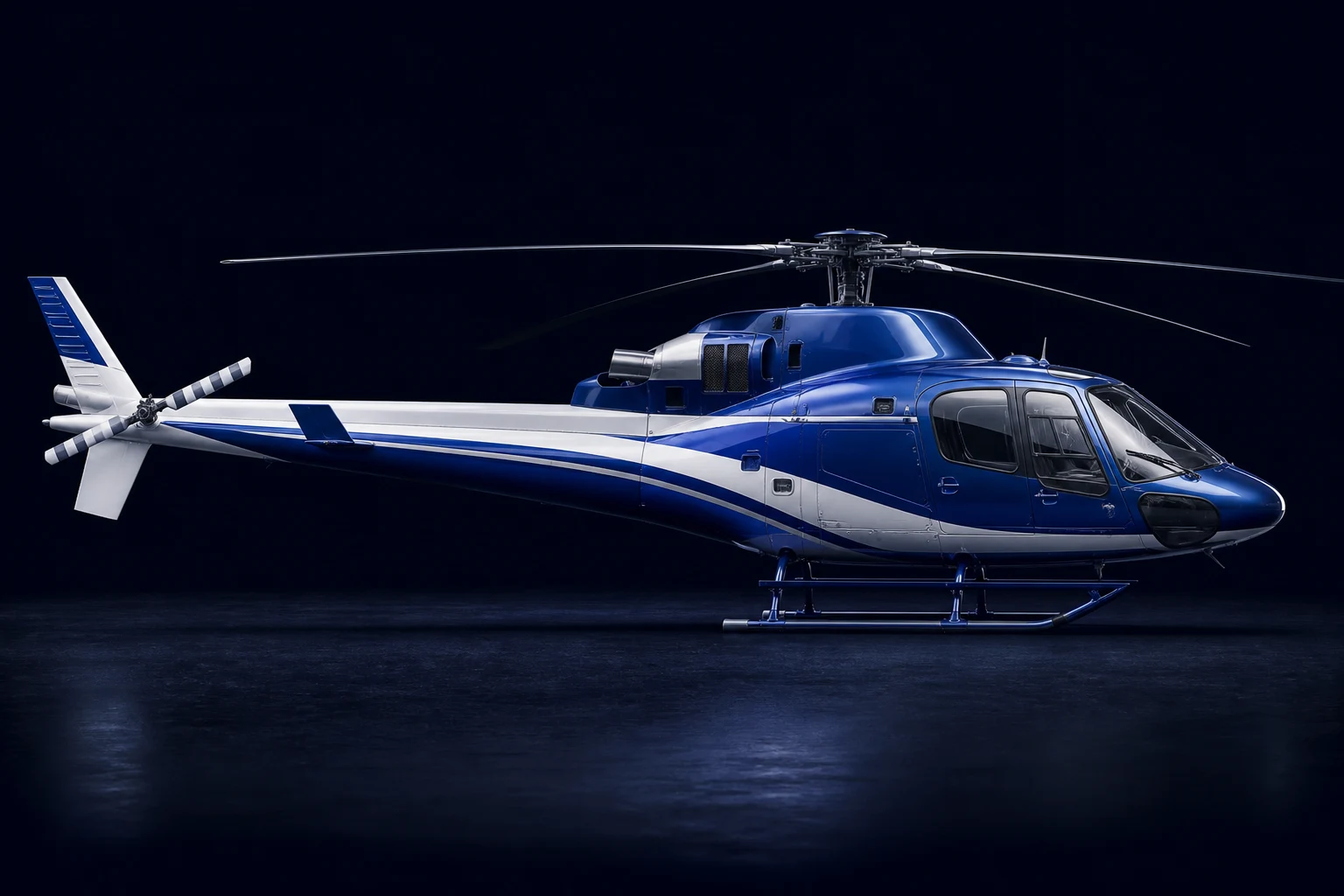
The Maibatsu Frogger is what happens when someone looks at the light utility helicopter market, sees a design that hasn't fundamentally changed in decades, and decides to fix all of it at once. It's a five-seat single-turbine helicopter with a shrouded tail rotor, a wide flat-floored cabin, a modern rotor system, and a noise signature low enough that it's approved for operations the older types are banned from.
The headline feature is the enclosed tail rotor - a multi-blade fan housed inside the vertical fin instead of an exposed rotor on a boom. It's quieter, it's dramatically safer around people on the ground, and it makes the aircraft usable at helipads with noise restrictions, which in a tourism economy like Leonida's translates directly into flying hours. Tour operators over the Vice City beach strip and the Keys run Froggers specifically because they can fly routes and schedules that a Maverick can't.
The cabin is the other half of the argument. It's genuinely wide, with a flat floor and forward-facing seating for four passengers, big windows, and a noise level that lets people hold a conversation. For charter work, executive transfers, and medical transport, that's the entire product - the flying is a commodity, the experience is what gets booked again.
In Leonida the Frogger occupies the space just above the Maverick: newer, quieter, more comfortable, more expensive, and increasingly the aircraft that shows up when somebody is paying properly. It's less common and less iconic, but it's better at almost everything.
Design
The Frogger's shape is modern and rounded where the older light helicopters are angular. A large one-piece windscreen wraps the forward cabin, the fuselage swells to a genuinely wide passenger compartment amidships, and the tail boom tapers back to a broad vertical fin containing the shrouded anti-torque fan. High-set horizontal stabilizers with endplate fins sit ahead of it.
The cabin is the design's whole justification. A flat floor with no transmission tunnel, forward-facing bench seating for four behind the pilot, wide sliding doors on both sides, and a rear baggage compartment accessible from outside. Interior noise is low enough that headsets are a courtesy rather than a necessity in the back - a claim no two-blade helicopter can make.
The main rotor is a modern composite system, multi-blade and hingeless, delivering both a smoother ride and better control response than the older articulated heads. Skid gear keeps the aircraft light and simple. Finishes in Leonida run to tour-operator tropical schemes, corporate metallics, medical white with high-visibility markings, and the muted single-color paints favored by executive charter - the Frogger is a considerably more presentable aircraft than its competitors and operators tend to spend accordingly.
Performance
The Frogger is quicker than the older light singles, cruising comfortably in the low one-thirties with better hot-and-high performance thanks to a more modern engine and rotor system. Range is good and fuel burn is competitive, which matters more to charter economics than top speed ever will.
Handling is smooth and modern. The hingeless rotor gives crisp, precise control response without the vibration that defines the two-blade types, and the shrouded tail fan provides consistent authority in crosswinds - the older exposed tail rotors get vague and demanding in the gusty conditions common along the Leonida coast. It's a noticeably easier aircraft to fly precisely, particularly in a hover next to a building or over water.
The limitations are the ones common to the class. No armor, a glass cabin, and a maximum load of five people means it's transport, not a combat platform. The shrouded fan is more efficient in the cruise but slightly less effective at very low airspeed in a strong crosswind than a well-flown conventional tail rotor. And the aircraft's noise advantage cuts both ways - pilots consistently report that people on the ground notice it later, which is useful, and that they themselves notice obstacles later for the same reason, which is not.
Driving & Gameplay
The Frogger is the upgraded Maverick and plays the same role better. Five seats instead of four, more speed, better handling, and a wide flat cabin that makes loading and unloading a crew genuinely faster. For any objective that involves moving people by air, it's the more capable choice, and the improved hot-weather performance means it doesn't run out of power in the situations where the Maverick starts to.
Its distinguishing advantage is quiet. The shrouded tail fan and modern rotor mean ground NPCs react to it later and from closer, which turns a lot of approaches that would be compromised in a Maverick into approaches that work. Landing on a rooftop, holding over a compound, or coming in over water at night are all measurably easier in a Frogger, and players who do a lot of aerial infiltration learn to prefer it strongly.
The drawbacks are cost and availability. It's meaningfully more expensive than the Maverick and there are far fewer of them scattered around the map to steal, so the Frogger tends to be an aircraft you own rather than one you find. Like every light helicopter, it's unarmored and unarmed - the advantage it offers is arriving unnoticed, not surviving being noticed.
Customization
The catalog is broad and mostly practical. Interior configurations run from five-seat standard through executive four-seat leather with a center console to a medical fit with a litter and equipment racks, or a stripped utility layout with a cargo floor. Livery options are extensive, since operators in this class care about how the aircraft looks on a brochure.
Mission equipment is where operators spend real money. A nose-mounted camera turret and a searchlight for news and patrol work, a cargo hook and long line for utility lifting, a rescue hoist above the right door, floats on the skids for overwater operations in the Keys, and an air-conditioning package that in the Leonida climate is not remotely optional. Extended-range fuel and a night-vision-compatible cockpit round out the list, and the quiet-rotor tip package pushes the acoustic signature down far enough to qualify for the most restricted urban pads.
Locations
Froggers concentrate where the money and the noise rules are. The tour operator pads along the Vice City beach strip run them heavily, the downtown rooftop helipads with residential neighbors nearby are effectively Frogger-only, and the executive ramps at Vice City International keep several on charter.
Outside the city they turn up at the Keys resorts running guest transfers, at hospital pads as air ambulances, at the Mount Kalaga ranger facility for park patrol and rescue, and at Gellhorn Regional on the general aviation apron. Corporate compounds in the industrial belt and the larger private estates on the causeway both maintain their own - the Frogger is the aircraft you buy when you want a helicopter that doesn't make your neighbors hate you.
In Leonida
Maibatsu entered the rotorcraft market late and treated that as an advantage, designing around modern materials, modern avionics, and - crucially - modern noise regulation rather than adapting an older airframe. The shrouded tail fan was the boldest choice, expensive to develop and initially resisted by operators who distrusted anything unfamiliar, and it became the feature that sold the aircraft once the noise rules tightened.
Leonida proved the case faster than anywhere else. As Vice City's downtown residential density increased and helipad noise complaints turned into helipad restrictions, operators discovered that their older aircraft were simply losing access to the most valuable landing sites in the state. The Frogger could still fly them. Within a few years the entire premium end of Leonida's charter and tour market had converted, and the aircraft that Maibatsu's competitors dismissed as an over-engineered novelty had quietly taken the profitable half of the business.
Trivia
- The shrouded tail fan is significantly safer around people on the ground, which is why resort and hospital pads with foot traffic increasingly specify the type exclusively.
- Its noise footprint is low enough to qualify for downtown Vice City rooftop pads that the older two-blade helicopters have been banned from.
- The flat cabin floor with no transmission tunnel means a crew can board or exit noticeably faster than from a conventional light helicopter.
- Pilots report that the aircraft's quietness works against them too - the reduced external noise means people and obstacles register later than they expect.
- Air-conditioning is technically an option and is fitted to essentially every Frogger sold in Leonida, for reasons any resident can explain in one word.