Aircraft
Jobuilt P-996 LAZER
Jobuilt · Multirole fighter
- Seats
- 1
- Top speed
- ~1,150 knots / 1,320 mph
- Price
- Restricted - no civil sale
- Mass
- 9,200 kg
- Real-world inspiration
- General Dynamics F-16 Fighting Falcon
- Availability
- There is no purchase path and no legitimate access. Taking one requires getting onto a defended mainland ramp, into a cockpit you have not been trained on, and off a runway before the alert aircraft are rolling.
- Overview
- A single-seat supersonic fighter that turns the entire state into a two-minute flight - if you can get it off the mainland ramp.
Description
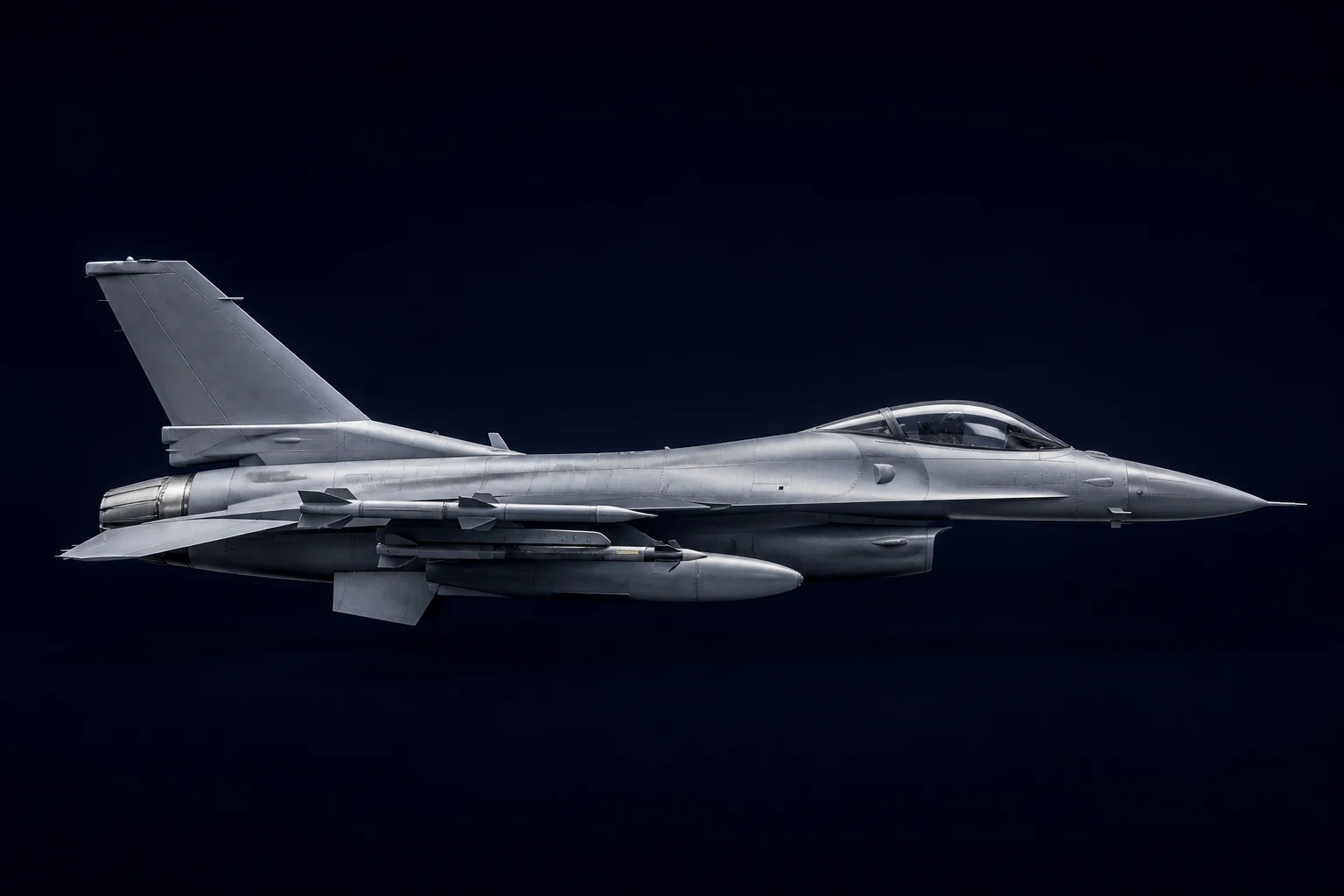
The Jobuilt P-996 LAZER is the fastest thing in Leonida airspace and the single most consequential vehicle anyone can steal. It's a compact single-engine multirole fighter - one enormous turbofan, a blended fuselage, a cropped delta wing, and a bubble canopy - built around the idea that a small, light airframe with a very large engine will out-turn and out-accelerate anything heavier. It does.
Everything about the aircraft is subordinate to agility. The flight controls are fully computer-mediated, which is the only reason it flies at all: the airframe is deliberately unstable in pitch, and a set of computers makes hundreds of corrections a second to keep it pointed where the pilot wants. The side-stick controller and the reclined seat exist so the pilot can stay conscious under sustained high-G maneuvering. This is not a machine that was designed to be pleasant.
In Leonida terms, the LAZER collapses the map. The distance from the mainland coast to the far end of the Keys is a couple of minutes at cruise and considerably less if you're in a hurry. Any response to a stolen one has to be organized in that window, which is why the state's contingency planning for the scenario is less about interception and more about damage assessment.
Getting one is the hard part and always has been. The type operates exclusively from the restricted mainland installations - principally the Gellhorn Reserve field and Cape Verano - behind fencing, patrols, ready alert crews, and integrated air defenses. Every part of that is designed with the specific assumption that someone will eventually try.
Design
The LAZER is one continuous shape. The wing blends into the fuselage through a smooth strake that runs forward to the cockpit, generating lift and controlled vortex flow at high angles of attack rather than simply attaching a wing to a tube. The result is a fighter with no hard transition anywhere on its upper surface and a distinctly organic profile from above.
The cockpit is the type's signature. A single-piece bubble canopy with no forward bow gives genuinely unobstructed visibility in every direction - the best of any aircraft in Leonida - and the pilot sits on a seat reclined about thirty degrees, controlling the aircraft with a small pressure-sensitive stick on the right console instead of a conventional center column. There is very little space and no comfort whatsoever.
The air intake sits underneath the fuselage in a fixed simple duct, feeding the single large turbofan that occupies most of the aircraft's volume. Nine hardpoints carry ordnance and fuel; the wingtip rails are almost always occupied. Standard finish is a two-tone air-superiority grey with low-contrast markings, tail codes, and a squadron badge on the fin that maintenance crews take considerably more seriously than the pilots do.
Performance
The LAZER is supersonic, and the number understates it. It accelerates in level flight faster than most aircraft accelerate in a dive, climbs at a rate that makes altitude effectively free, and holds a top speed that puts it beyond the reach of anything else operating over Leonida. Crossing the state takes minutes; reacting to a LAZER takes longer than that.
Maneuverability is the other half of the story. The relaxed-stability airframe and fly-by-wire control laws let it sustain turn rates that would tear a conventional fighter apart, and the reclined seat and side-stick exist to let the pilot function while it does. In the hands of someone who knows what they're doing it can point its nose almost anywhere, almost instantly.
The costs are fuel, runway, and difficulty. Endurance at high power settings is measured in a small number of minutes, which is why the aircraft carries external tanks on almost every real sortie. It needs a proper runway to take off and a longer one to land, ruling out improvisation entirely. And landing it is genuinely hard - the approach is fast, the sight picture is unfamiliar, and the margin between a good landing and a destroyed aircraft is not generous.
Driving & Gameplay
The LAZER is the top of the escalation ladder and the game treats it that way. It can reach anywhere on the map almost immediately, it can destroy essentially any ground or air target it engages, and nothing available to a routine response has the performance to catch it. For a short window after you get one airborne, you are the most capable thing in Leonida.
That window is the whole design. Fuel is short, the aircraft must land on a real runway, and every runway long enough is either defended or watched. The interesting play with a LAZER isn't the flying, it's the plan - knowing what you're going to do with the handful of minutes you have and where the aircraft is going to end up when you're finished with it.
Getting one is a set piece in itself. The mainland installations are built as a genuine problem with multiple viable approaches - the perimeter, the patrol pattern, the alert response, the air defense envelope - and the raid is the memorable part far more often than the sortie that follows. Most players lose their first LAZER on landing, which is exactly the joke the difficulty curve is telling.
Customization
The LAZER is not customized so much as configured. The nine hardpoints accept air-to-air missiles, unguided and guided air-to-ground stores, gun pods, and external fuel, and the choice between them is the only meaningful decision most operators make. A centerline and two wing tanks transform the aircraft's endurance from token to useful at a real cost in acceleration and turn rate.
Beyond stores, options come down to fit and finish. Paint runs to the standard two-tone grey, a darker overwater scheme, and the unmarked finishes applied to airframes whose current custody is unclear. Tail codes and squadron badges can be applied or removed. Sensor and countermeasure fits vary by airframe. What cannot be improvised is depot-level maintenance on the engine and flight control computers, which is the practical reason no stolen LAZER stays flyable for long.
Locations
The LAZER lives at two places in Leonida and nowhere else. The Gellhorn Reserve field, inland from Port Gellhorn, hosts the state's fighter detachment on a hardened ramp with alert shelters at the runway threshold. Cape Verano Naval Air Station on the mainland coast maintains a smaller number for maritime work alongside its vertical-flight units.
Both are genuinely defended. Fencing, vehicle patrols, an inner ramp perimeter, ready-alert crews who can be airborne in minutes, and integrated air defense that treats an unidentified aircraft entering the restricted block as a decision already made. The airspace above the Kalaga range complex is also permanently restricted, and the aircraft you'll see there are the same ones, doing the thing they were built for.
In Leonida
Jobuilt's fighter program began as a deliberate reaction against the trend toward large, complex, expensive interceptors. The pitch was a small aircraft with one engine and one pilot that would cost a fraction as much and turn better than anything in the sky, and the resulting design - relaxed stability, fly-by-wire, bubble canopy, side-stick - was radical enough that a substantial part of the industry expected it to fail publicly.
It did the opposite, and the type has been in service long enough that the airframes at Gellhorn Reserve are older than most of the people flying them. Its Leonida presence is a function of geography: a long coastline, a lot of maritime traffic, and a state government that has historically been enthusiastic about federal aviation money. The installations grew around that, and so did the local mythology - the persistent, officially denied, endlessly retold stories about the times somebody got one off the ramp and what happened in the twelve minutes that followed.
Trivia
- The airframe is deliberately unstable in pitch and is only flyable because computers correct it continuously - pull the power on the flight control system and it departs immediately.
- The pilot's seat is reclined roughly thirty degrees specifically to raise tolerance to sustained high-G maneuvering.
- The one-piece bubble canopy has no forward bow, giving the best all-round visibility of any aircraft operating in Leonida.
- External fuel tanks are fitted on essentially every real sortie, because internal endurance at high power is measured in single-digit minutes.
- The airframes based at the Gellhorn Reserve field have been in continuous service longer than most of their assigned pilots have been alive, a fact the maintenance crews mention constantly.